Riverside’s historic Mission Inn sold to local tribe
After 33 years under the stewardship of co-owners Duane and Kelly Roberts, the historic Mission Inn Hotel & Spa in downtown Riverside has been sold. The sale ends months of speculation regarding a potential sale that surfaced shortly after the passing of Duane in early November of 2025. Financial terms of the transaction to the Yuhaaviatum of San Manuel Nation tribe of nearby Highland were not disclosed.
Kelly Roberts, who was the wife of Duane, stated the following regarding the sale:

“It has been the honor of a lifetime to serve as stewards of The Mission Inn,” said Kelly Roberts, vice chairman and and chief operating officer of the Mission Inn, in a statement. “Duane and I poured our hearts into preserving its legacy while evolving it for future generations. I am incredibly proud of what we built together and deeply grateful to our team, the Riverside community, and every guest who has walked through its doors.
“I have great confidence that Yuhaaviatam of San Manuel Nation will carry this legacy forward with the same care, respect, and vision.”
Riverside Press-Enterprise – May 4, 2026
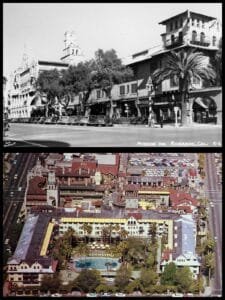
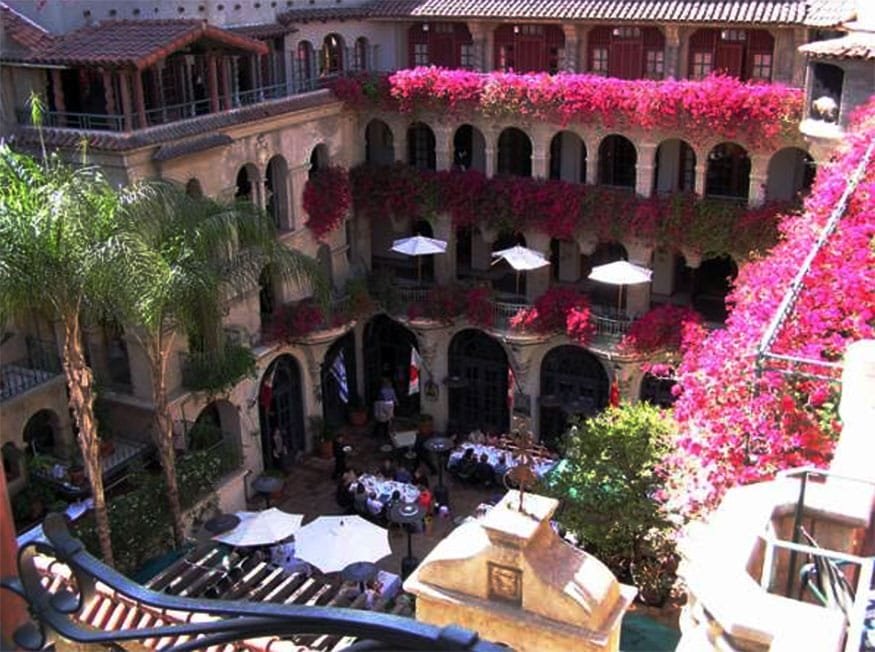
The Mission Inn itself began in 1876 as the Glenwood Cottage, a modest adobe/boarding house built by Christopher Columbus Miller, who had received a full city block in a prime location downtown as payment for his surveying and engineering work on expanding Riverside’s early canal system (pre-Gage Canal). His son, Frank Augustus Miller, would soon purchase the entire property in 1880. And over a 30-year period beginning in 1902, Frank Miller would build the magnificent and eclectic Mission Inn we see today.
Following the death of Frank Miller in 1935, the Inn was managed by Miller’s daughter Allis and her husband Dewitt Hutchings. This family stewardship would continue until their deaths in 1953-54, at which time family heirs sold the Inn to San Francisco hotel magnate Ben Swig (who owned San Francisco’s Fairmount Hotel). After initial success and stability, the Inn would slowly decline over the next two decades — potentially facing the wrecking ball at one point — before community leaders stepped in to save it (and encouraged the City of Riverside to purchase it in 1976 via its Redevelopment Agency).

However, the City (and its Redevelopment Agency) neither had the expertise nor the money to be a hotelier, so the Inn mostly languished until being sold in 1985 to Carley Capital Group of Madison, Wisconsin, who had refurbished a few historic hotels at that point. But by late 1988, Carley found out that the Mission Inn was a very unique — and very expensive — restoration project.
Carley had begun what was expected to be a two-year, $28 million restoration and renovation in June 1985. However, cost overruns and delays caused financial strains for Carley, resulting in Chemical Bank of New York eventually foreclosing on the loan (now hovering around $40 million) just as the Inn was about to reopen in December 1988 as the Omni Mission Inn.
The Inn would remain closed with Chemical Bank reportedly spending several million dollars more to finalize the major renovation before finding a buyer (Duane) and selling the Inn to him for $15.6 million in December 1992 (a real bargain relative to its restoration costs). The complex deal reportedly involved Chemical Bank, Riverside Redevelopment Agency, Mission Inn Foundation, and Historic Mission Inn Corporation (HMIC) – the latter set up for Duane Roberts to purchase the Inn. The deal included financial assistance/backing from the City to HMIC (with little up front by Duane) and was essentially a deal to unload a moderate asset from the books as a write-off for the bank (with tax incentives for HMIC and a potential — and very important — catalyst for the City in its efforts to reinvigorate downtown).
The hotel partially reopened on December 30, 1992 with about 50 of the 240 rooms ready. Full reopening would come several months later, with official reopening ceremonies taking place May 1-2, 1993. (Overall restoration and renovation of the Inn has been reported to have eventually cost between $45-$50 million.)
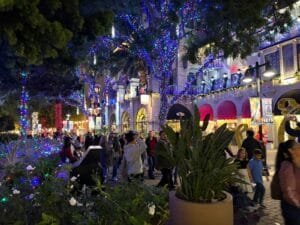
Reports over the years have stated that Duane and Kelly reinvested several million dollars into the Inn over their 30-plus years of ownership, with some being used to establish and grow the annual Festival of Lights. Duane’s steadfast stewardship of the Inn during the early years following its rebirth — and which continued during his three-decade ownership — bestowed upon Duane the honorary title as “Keeper of the Inn” (original owner Frank Miller was referred to as “Master of the Inn”).
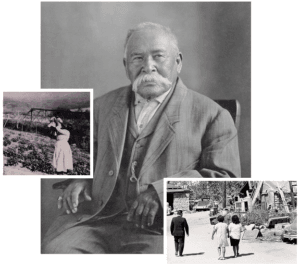
As for the Yuhaaviatum of San Manuel Nation, their local roots go back long before California was even a state. According to the tribe, “Yuhaaviatam” (pronounced “yu-HAH-vee-ah-tahm”) means “People of the Pines” in the Maara’yam language of the Serrano people (aka “highlanders”). Conscripted into labor duties for the Spanish missions and later forced out of Big Bear Valley by American expansion, the tribe was eventually placed upon the newly-created (1891) San Manuel reservation in Highland, just east of San Bernardino.
As with the majority of native tribes, the San Manuel Band of Mission Indians (as the tribe was then known) managed to survive for several decades. However, economic opportunities dramatically changed for the better following the 1987 U.S. Supreme Court case “California v. Cabazon” that reaffirmed gaming rights of tribal nations (via tribal sovereignty). The landmark case led to the United States Congress passing the Indian Gaming Regulatory Act (1988) that allowed expansion of gaming on tribal lands with federal regulation and requiring tribal-state compacts/agreements.
Since a major casino expansion in 2005, the tribe has played a significant role in the Inland region’s economy and entertainment (the latter receiving a major boost following the April 2022 opening of the 3,000 seat Yaamava Theater). Likewise, they understand the importance of the Inn to Riverside and the greater Inland SoCal region and appear eager to continue its legacy:
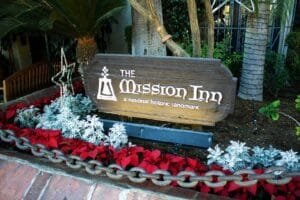
“The Mission Inn holds a special place in our hearts,” Tribal Chairwoman Lynn Valbuena said in a statement. “Generations of our family love the inn for its charming ambience and for the memories we’ve made there over the years. We recognize its historic, economic and cultural significance to Riverside and the region and would be delighted to include The Mission Inn in our non-gaming hospitality portfolio.”
Raincross Gazette – May 4, 2026
The Inn will add to the tribe’s growing portfolio, which also includes — among other properties — the luxurious Waldorf Astoria Monarch Beach Resort & Club in Dana Point and the Palms Casino in Las Vegas. We’re very glad to see that the sale has gone to a local entity, particularly one with the apparent resources and desire required to own a unique and distinctive structure like the Inn. And so far, the response from the local community regarding the sale has been mostly positive.
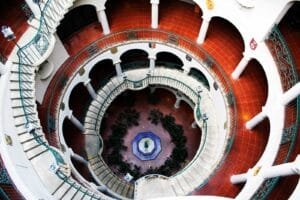
Without a doubt, the Mission Inn has been an important catalyst for the rebirth — and rediscovering — of downtown Riverside by both residents and visitors alike. Its cultural and economic impact on Inland SoCal (estimated to be $154 million in 2023) cannot be overstated. Indeed, it’s one of the most unique structures in all of Southern California (and even within the United States).
Duane and Kelly Roberts are to be commended for their three-decade stewardship of the Mission Inn, in which both the Inn and downtown Riverside mutually prospered. We have high hopes, expectations, and trust that the Inn’s historic legacy will be respected and will continue — along with downtown Riverside’s increasing profile — under this new era of local ownership.
Related
- Riverside Press-Enterprise – Riverside’s historic Mission Inn sold to San Manuel Nation (May 4, 2026) | Mission Inn has long legacy in Riverside, from ‘cottage hotel’ to more recent ‘rebirth’ (May 4, 2026)
- Raincross Gazette – The Mission Inn Heads to New Ownership: Yuhaaviatam of San Manuel Nation (May 4, 2026)
- Yuhaaviatam of San Manuel Nation – SMIA Enters Into Agreement to Purchase Historic Mission Inn Hotel & Spa in Riverside (May 4, 2026)
Previous
- RaincrossSquare.com – 33rd annual Festival of Lights in Riverside (December 2025)
Update
(June 6, 2026) — Completion of the sale of the Mission Inn Hotel & Spa from the Historic Mission Inn Corporation (Duane and Kelly Roberts) to the San Manuel Investment Authority (SMIA / Yuhaaviatam of San Manuel Nation) was officially announced by the tribe on May 29, 2026. According to SMIA, day-to-day management of the Inn will be provided by Pyramid Global Hospitality, “a leading hotel and hospitality management company with more than 200 properties under management worldwide.”
Community members have primarily expressed optimism and high hopes with the new ownership by a local entity that has very deep roots in the region. We too hold similar optimism (and expectations). And again, the former owners — Duane and Kelly Roberts — are to be commended for their 30-plus years of stewardship.

Sadly, however, the transfer of ownership hasn’t gone without some controversy. Prior to the close of escrow, at least two prominently displayed art pieces — “California Alps” (William Keith, 1874) and “Charge up San Juan Hill” (Vasily Vereshchagin, 1900) — that were purchased by Frank Miller over 100 years ago and on display for decades at the Inn were reportedly removed from the premises, possibly to be retained by the former owner. Both of the very large art pieces — measuring approximately 6 x 10 (feet) and 6 x 8 (feet) respectively — were taken down off the walls and wrapped in plastic for apparent removal. Left behind in their place were faded scars where the paintings once hung.
The two paintings join other artifacts that appear to have also been removed in recent years, including a Steinway piano and a Goddess of Pomona statue, the whereabouts of which are apparently unknown (possibly placed in storage somewhere). But most notably missing is the one-of-a-kind Taft Chair, which was specially built by Frank Miller for the 1909 visit to the Inn by then President William Howard Taft. To the chagrin of Taft, Miller had the oversized chair built to fit the “plus-sized” president during his visit. For decades, it was on display in the main lobby as a distinctive piece of Mission Inn history.

The sudden taking down of the paintings caught many by surprise and caused concern by city leaders, preservationists, and residents alike. However, an attorney statement released at the time of the removal (and prior to the close of escrow) stated that “the artwork and personal items in question are the property of Kelly Roberts and her late husband, Duane Roberts.” And indeed, that may very well be the case on account it appears that formal/binding documentation of ownership for “movable objects” and other artifacts may have been vague and/or not fully finalized during a 1992 agreement between the City of Riverside’s Redevelopment Agency, the Mission Inn Foundation, and the Historic Mission Inn Corporation (Duane Roberts). It also appears the City and the Foundation simply accepted Duane Roberts good faith assurances in retaining existing artifacts with the Inn.
It’s unclear at this time whether the two paintings or any of the other reportedly missing artifacts will someday reappear at the Mission Inn. It’s possible that some — or all — were simply placed in storage and will be found by the new owners. But if not, we sincerely hope their return — particularly the Taft Chair — will occur in due time (even if as a donation) and without any potential messy court battles. Just returned. In good faith. Back to their home.
- Yuhaaviatam of San Manuel Nation – San Manuel Investment Authority Completes Acquisition of The Mission Inn Hotel & Spa (May 29, 2026)
- Raincross Gazette – The Mission Inn Artifacts Dispute Is More Complicated Than It Looks (May 29, 2026) | The Mission Inn’s New Stewards, Welcomed and Watched (May 11, 2026)
- Riverside Press-Enterprise – Art removal by owner of Riverside’s Mission Inn is called ‘vindictive’ (May 21, 2026)
Sources: Riverside Press-Enterprise (PE-20260504, PE-20260521); Raincross Gazette (RG-20260504, RG-20260529); “Historic Mission Inn” (Friends of the Mission Inn, 1998); “Pursuing Eden” (Joan H. Hall, 2008); RaincrossSquare.com; Yuhaaviatam of San Manuel Nation (website); California Nations Indian Gaming Authority (website); NOTE: Published dates for some online versions of newspaper articles cited may not match their archival source date.
Clarification (07/2026): Added info to better clarify the sale of the Mission Inn and the deal involving Chemical Bank, City/Riverside Redevelopment Agency, Mission Inn Foundation, and Historic Mission Inn Corporation.