Preview: Center for Social Justice & Civil Liberties

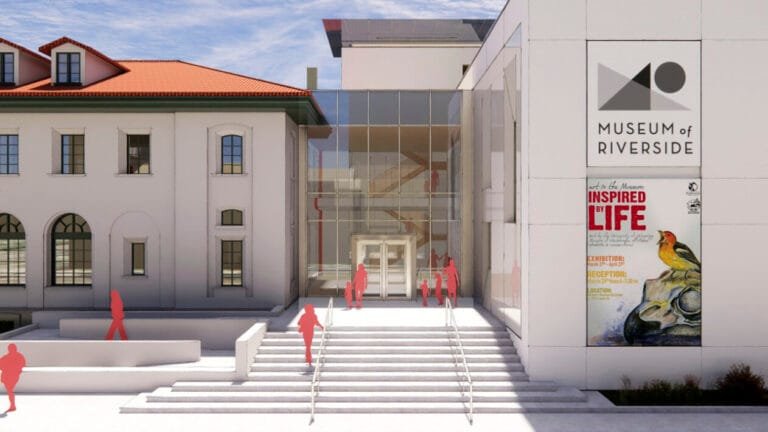
In late June, we attended the “preview opening” for Riverside Community College District’s “Center for Social Justice & Civil Liberties” museum, which is located inside the newly-restored Riverside Finance Company / Citrus Belt Savings & Loan building.
Built in 1926, the building’s Spanish Baroque (Churrigueresque) facade has been painstakingly restored following an 18-month, $6 million project. Its finely detailed exterior had been covered up by a sleek mid-century facade in 1961 — a modification that essentially preserved the original facade behind it.

The two-level interior has been completely remade into a museum that houses the extensive collection (8,000 pieces) of RCC alumna and nationally-prominent artist, Miné Okubo (1912-2001). It also houses several “social justice” narratives by prominent local citizens, including the Okubo & Harada families, Rupert Costo, Tomas Rivera and even Mission Inn builder (and world peace promoter) Frank Miller.
Okubo, a native of Riverside of Japanese-American descent, graduated from Riverside Junior College (RCC) in 1933 before pursuing a fine arts degree at UC Berkeley. Okubo — along with over 100,000 other Americans of Japanese descent — was later interred under Executive Order 9066 at Camp Topaz in the Utah desert during World War II, setting the stage for her later art work and prominence.

Following her release, Okubo released “Citizen 13660” a first-hand account using art with limited narrative to document the war-time internment. Praised by critics, it was published in 1946 as the very first memoir by an internee. Okubo eventually moved to New York City, working as an illustrator for Fortune, Time Life and The New Yorker. She also continued pursuing her private art work. In 1974, Okubo was named “Alumnus of the Year” for RCC.
Also included as part of the Center is a small exhibit on the building itself, chronicling its history and restoration. We ourselves are proud to have contributed images for this very exhibit (and thank Hal Fischer Associates for requesting our participation).

The Social Justice center is the first phase of the RCC School for the Arts planned for the remainder of the block along Market Street and University Avenue. We highly recommend a visit to the museum, which will have regular hours beginning Fall 2012. It’s a unique opportunity to see how local people, stories and events helped influence “social equality” at the national level.
Previous
- RaincrossSquare.com – 3801 Market Street – Hotel Holyrood/Plaza (June 2011)
Related
- Riverside Community College District – Center for Social Justice & Civil Liberties Opens
- RCCD – Riverside School for the Arts
- Topaz Museum
- University of Washington Press – Citizen 13660
Sources: Riverside Community College, Center for Social Justice & Civil Liberties, City of Riverside, The Press-Enterprise
It came out beautiful, but are they going to paint it? It looks like it’s primered and ready to paint, but I suppose, that is the paint?
@George — Yes, the restoration came out very nicely. And yes, it is painted using a subtle palette of muted gray/white, which allows the architectural details to better stand out.