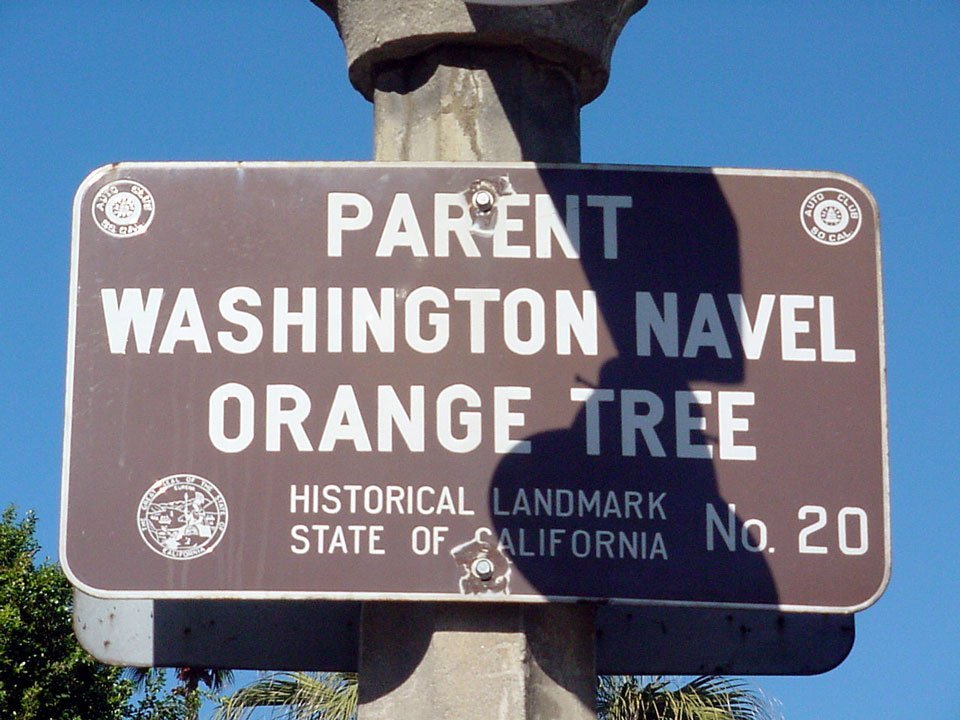
2000- California Historical Landmark No. 20 located in Riverside (RXSQ)

Riverside’s navel orange
From a recent edition of the Los Angeles Times:

The bronze plaque tells the tale: “The most valuable fruit introduction yet made by the United States Department of Agriculture.”

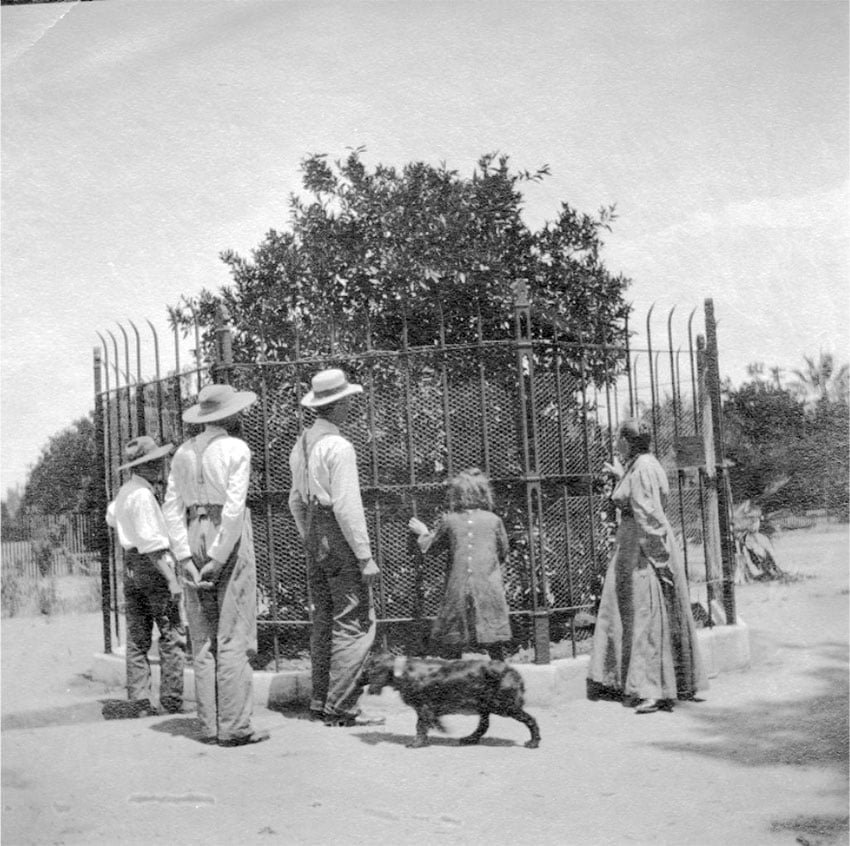
And there, at Magnolia and Arlington avenues in Riverside, stands the last of California’s original Washington navel orange trees, enclosed by an iron fence, looming over the plaque in the summer sun.

It is the tree that launched the storied citrus industry in the Riverside area, an industry that helped shape the world’s view of Southern California as a tropical paradise in the early 20th century.

Los Angeles Times – August 5, 2004
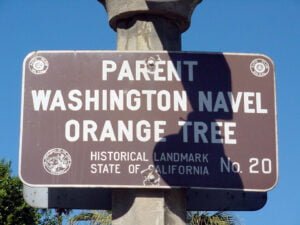
For those who don’t know, from this very navel orange tree (and a second sibling tree that died long ago) descended every Washington Navel orange tree in California, spawning California’s highly-successful — and very lucrative — navel orange industry. Some historians have referred to it as the second “gold rush” for California.

Related


04a-riv-2009c-tibbets-003-800.jpg

Image 9 of 60

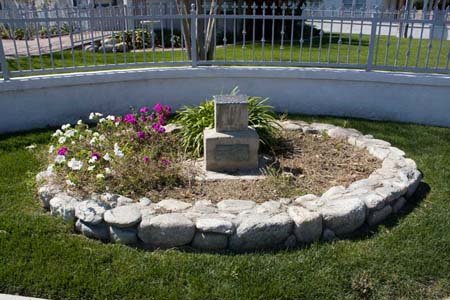
A tiny marker placed in 1935 by the daughter of Luther Tibbets was an attempt to give full credit for Riverside's parent Washington Navel orange trees to Luther (over Eliza).

Sources: Los Angeles Times (LAT-20040805), California Citrus State Historic Park; NOTE: Published dates for some online versions of newspaper articles cited may not match their archival source date.

2024 PAGE UPDATE: Added additional info/context; added link to June 2019 news article; removed outdated link to photo gallery and added 2011 photo slideshow.
Similar Posts

  • High-end homes

    With housing demand — and prices — shooting through the roof, it’s no surprise that a recent wave of high-end housing is taking root within the arroyos and valleys of Inland Southern California. The 580-acre Vellano project in Chino Hills will offer semi-custom homes priced between $900,000 and $1.5 million as well as 50 lots…

  • History vs. growth

    The old debate — new vs. old, dynamic vs. stagnant, growth vs. preservation, etc., etc. Such is always a tricky and dicey situation for any town or city. And, of course, everything is indeed subjective and relative. In other words, what exactly makes a structure “old,” “historic,” and/or “culturally significant”? In Riverside’s case, the city…

  • |

    Downtown police headquarters closes, to be replaced

    Public notice was given recently regarding the closure and planned demolition and replacement of the 1965-era, downtown headquarters for the Riverside Police Department. Located at 4102 Orange Street, the 33,000 square-foot, two-story (plus basement) building was designed by Riverside-based architectural firm of Ruhnau, Evans, Brown & Steinmann. It contained a pistol firing range and other…

  • The future? More vertical, more density — less housing tracts

    After decades of nearly unfettered sprawl, the time has come to seriously begin changing the basic developmental patterns of Inland Southern California. 2006Corona PointeCorona 2006Crossroads Corporate CenterMurrieta Ontario Downtown RiversideMetroPacific Properties, LLC Gone should be the days of leap-frogging, low-density development. In its place, should come more balance, both in densities and in types. More…

  • Updates, new stores coming to Riverside Plaza

    (UPDATE, Aug. 27, 2013: Thanks to commenter Matthew, we’ve added new images showing the exterior changes being made to the former Harris’ building. Note the designs, however, have changed somewhat from what is depicted within the images — namely, the reversing of the exterior escalator.) Construction has been underway for the past several months retrofitting…

  • |

    3801 Market Street – Hotel Holyrood/Plaza

    One of downtown Riverside’s oldest buildings dating from the late 1800s will soon disappear as a plan for an arts school for Riverside Community College District moves forward. Located at the southwest corner of Market Street and University Avenue, the building in question was originally built as a sanitarium by Dr. Clark Whittier, a wealthy…

Leave a Reply

Your email address will not be published. Required fields are marked *

This site uses Akismet to reduce spam. Learn how your comment data is processed.