Before digital and high-def, it was just ‘AUTO CENTER’
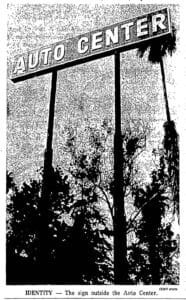
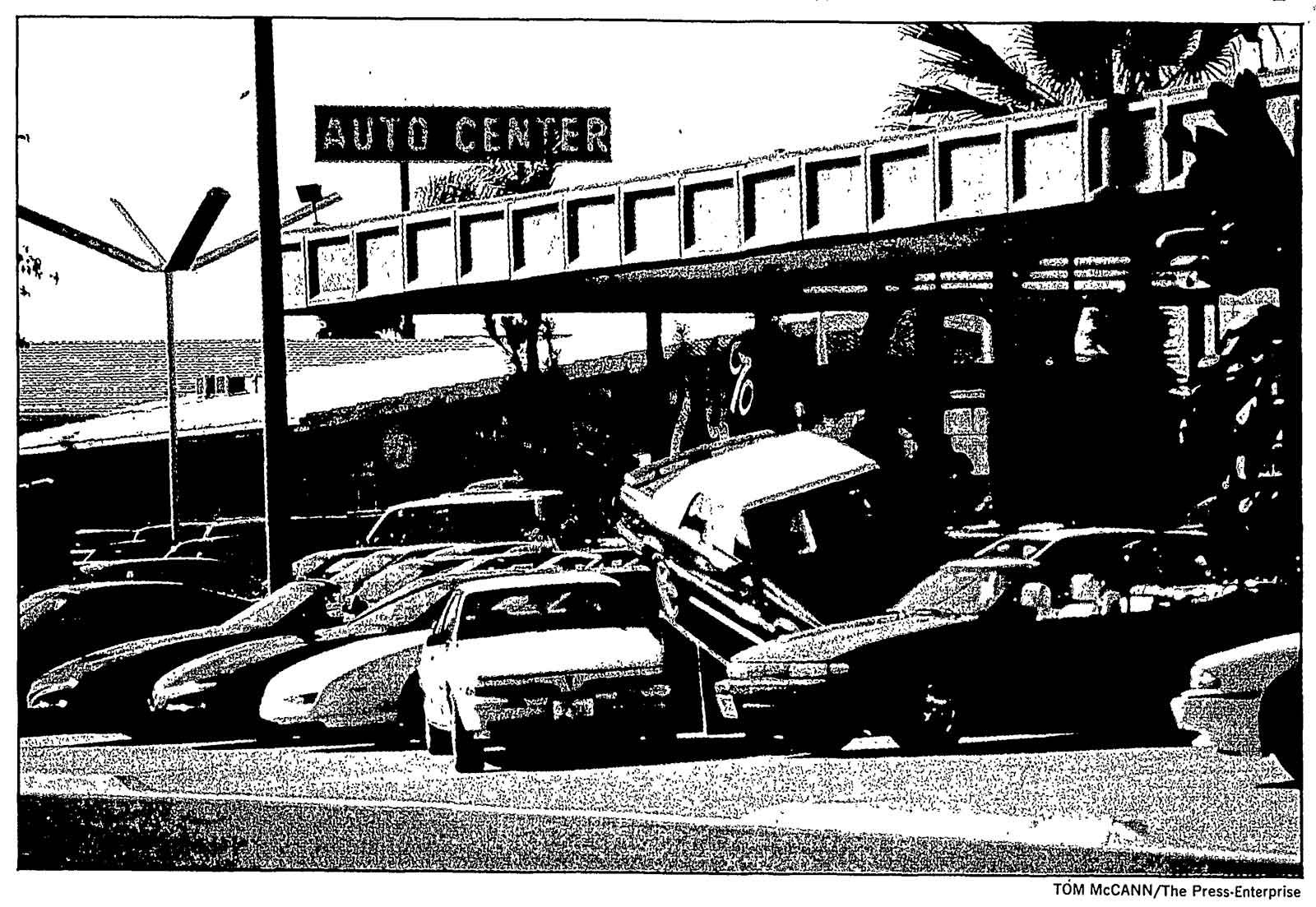
Recently, we came across newspaper images of the original sign for the Riverside Auto Center – images that had thus far eluded us. The sign was nondescript and simply comprised the words “AUTO CENTER.” It was simple but tall, serving its purpose for the first two-plus decades before increasing competition and electronic/digital messaging became more essential.
This original sign stood near the intersection of Adams Street and Indiana Avenue in the northwest corner of the Rubidoux/Dutton Motor Company property, adjacent to a nearby gas station. The 1965 newspaper image seems to indicate that the sign may initially have used traditional, white-colored channel lettering. However, if not initially, then at some point before 1980, the individual white letters had become lit in red neon, greatly enhancing visibility, especially at night.
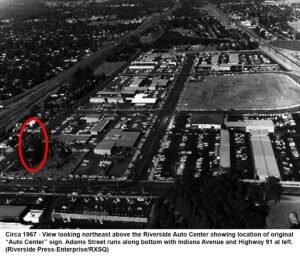
The sign’s overall height (75 feet) – and bright red neon – stood out, particularly considering Riverside would soon enact stricter signage codes. Nevertheless, the sign remained standing for at least 25 years, receiving an official variance in 1975.
By mid-1993, a 75-foot-tall, $250,000 replacement sign had been constructed in a different location, this time adjacent to the Riverside (91) Freeway (near Indiana Avenue at Susan Street). Unlike the original sign, however, this new version included a double-sided message screen that used an understated form of messaging via digital quartz-style (i.e., rotating digital cubes). The City approved the style – along with message timing requirements – as it was deemed less distracting and more aesthetic versus flashing bulb, Vegas-style messaging that had long been banned in Riverside.
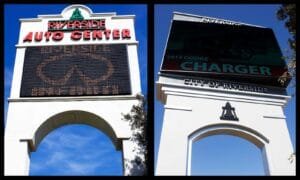
However, the digital quartz screen was eventually replaced sometime after the year 2000 – likely following the 2001 approval of Castle Park’s electronic sign – with a somewhat brighter and more traditional, double-sided electronic screen.
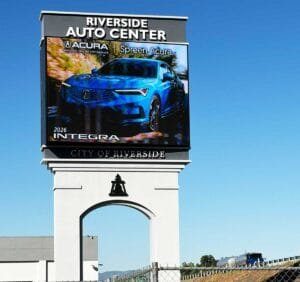
In 2013, a newly built (or at the very least, highly modified) structure replaced the circa 1993 version, making it the third overall sign structure for the Auto Center since its opening in 1965. Located in the same location as its predecessor, the nearly 82-foot-tall sign included much larger, high-definition color video screens that are slightly angled toward the freeway. In 2023, the double-sided screen received an upgraded version.
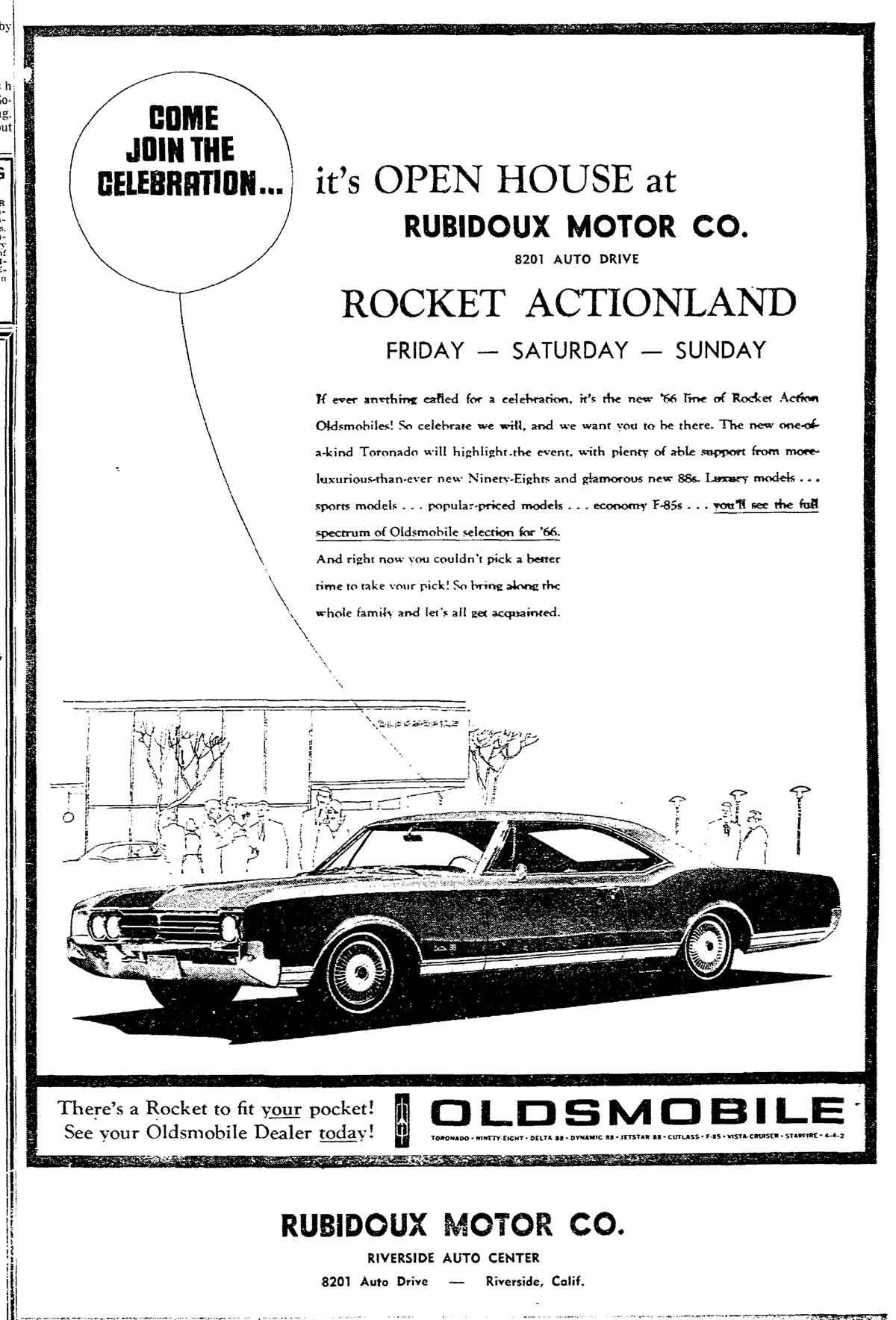
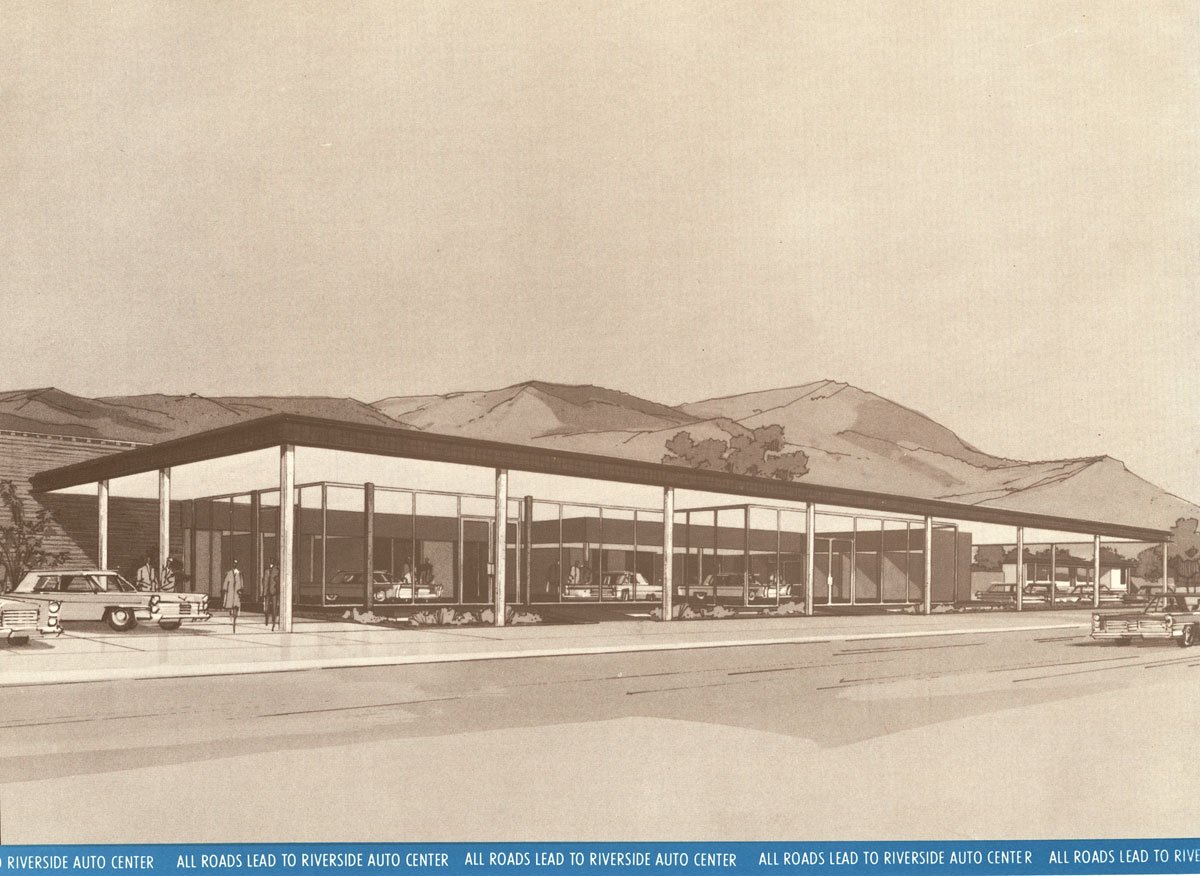
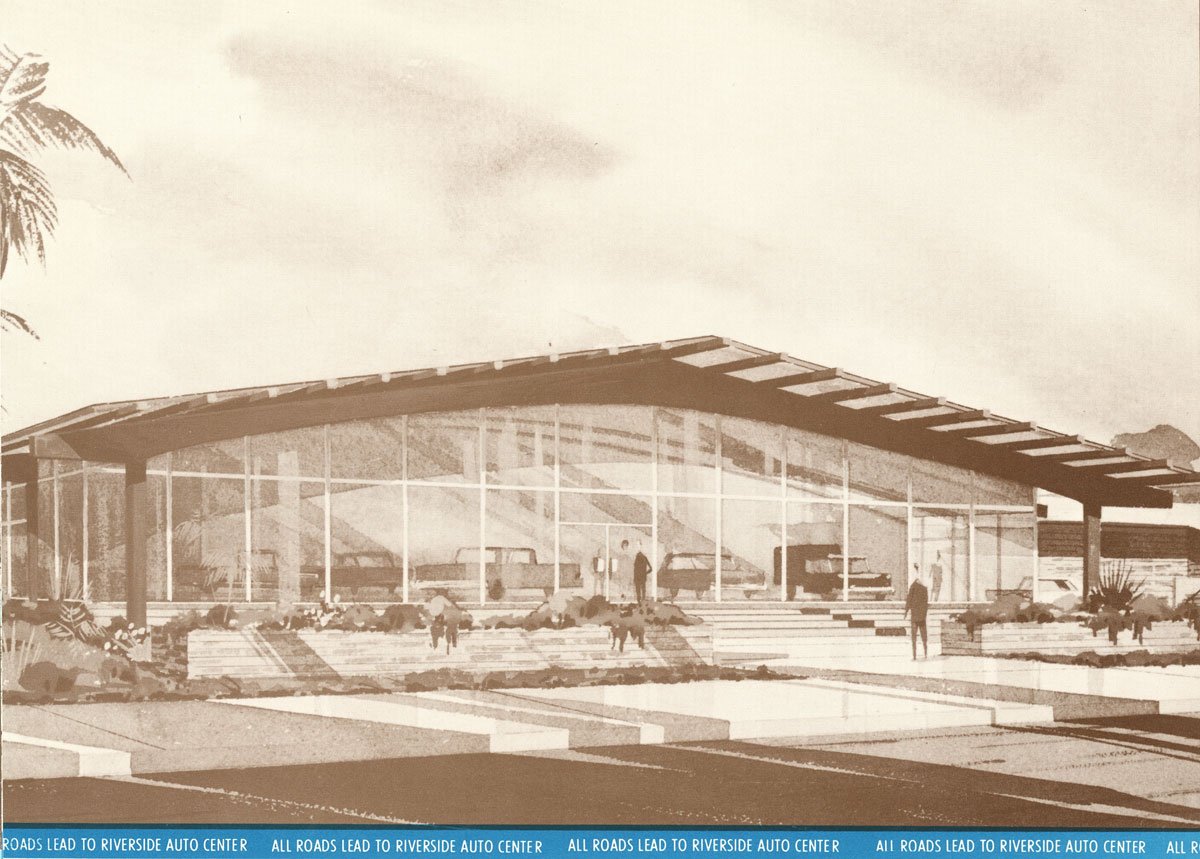
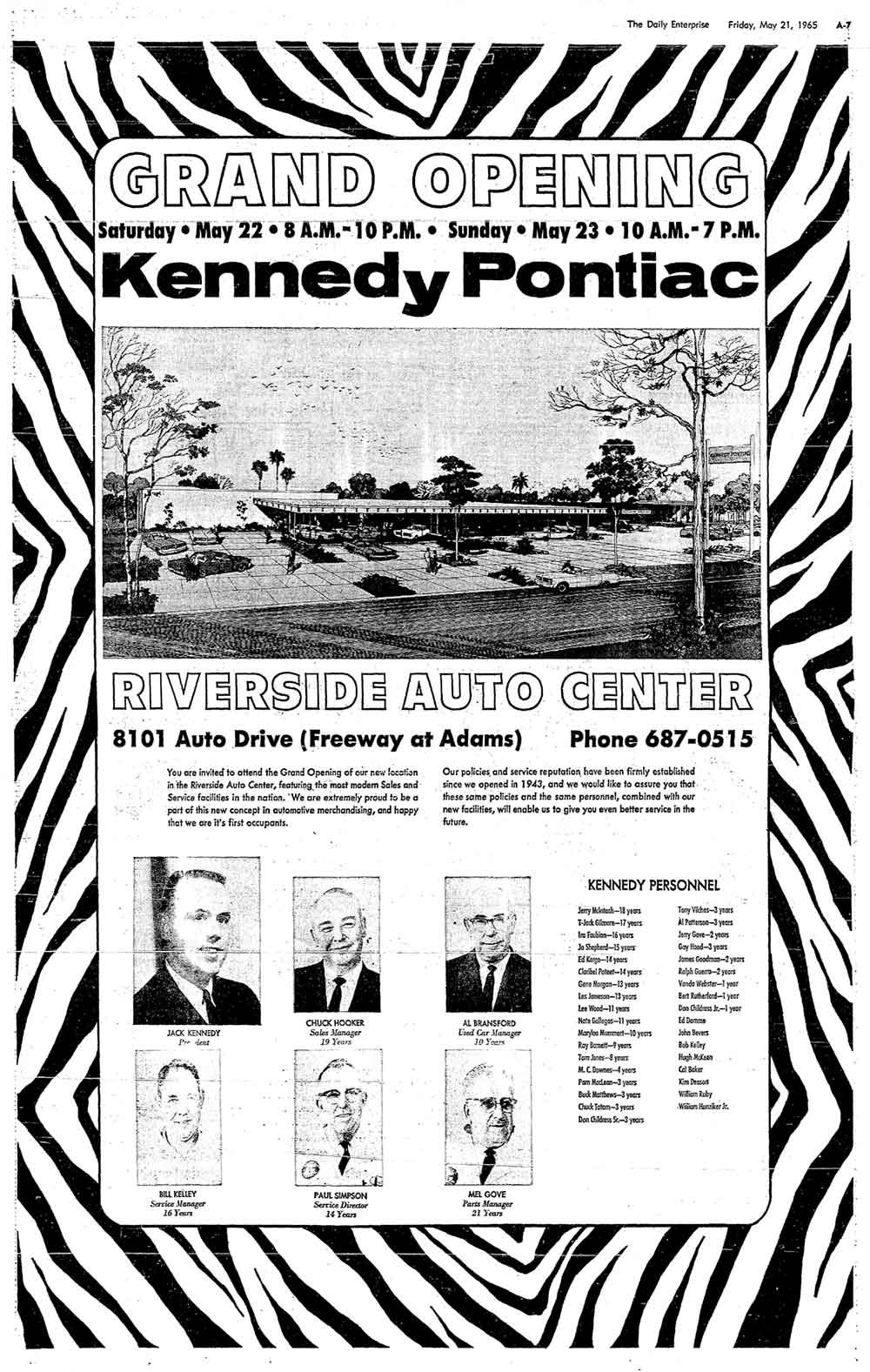
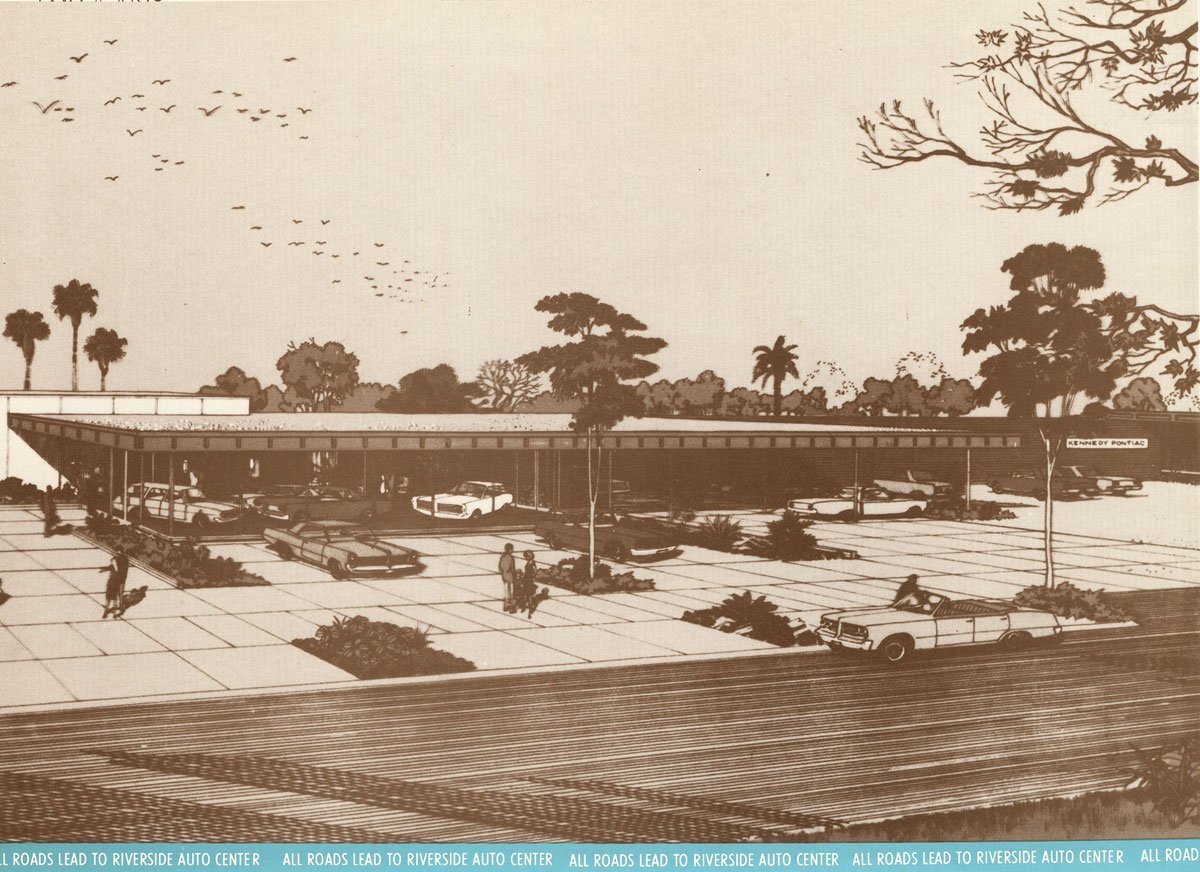
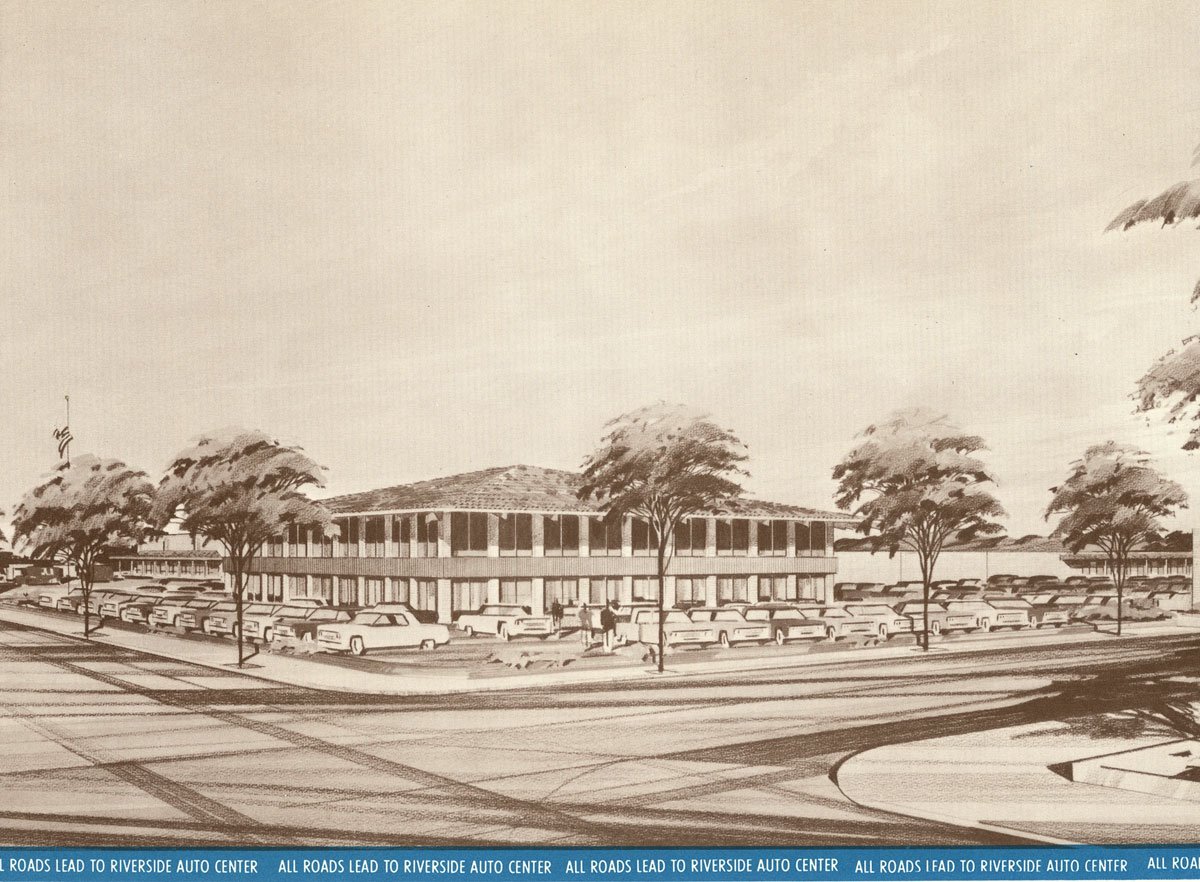
As for the Riverside Auto Center itself, it officially opened off Adams Street and the Riverside (91) Freeway in November 1965. When opened, it was billed as the world’s first auto center and has since been replicated numerous times across the United States.
A shopping center where all the stores sell cars is blooming in the orange groves around Riverside, California. There, notes Business Week, seven dealers have invested millions of dollars in the one-stop Riverside Auto Center, just five minutes by freeway from downtown.
…They may, states the magazine article, in fact, have set the mold for a new kind of car retailing.
Excerpts from Business Week (October 16, 1965) via Lamar (Missouri) Daily Democrat – November 6, 1965
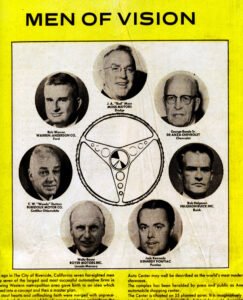
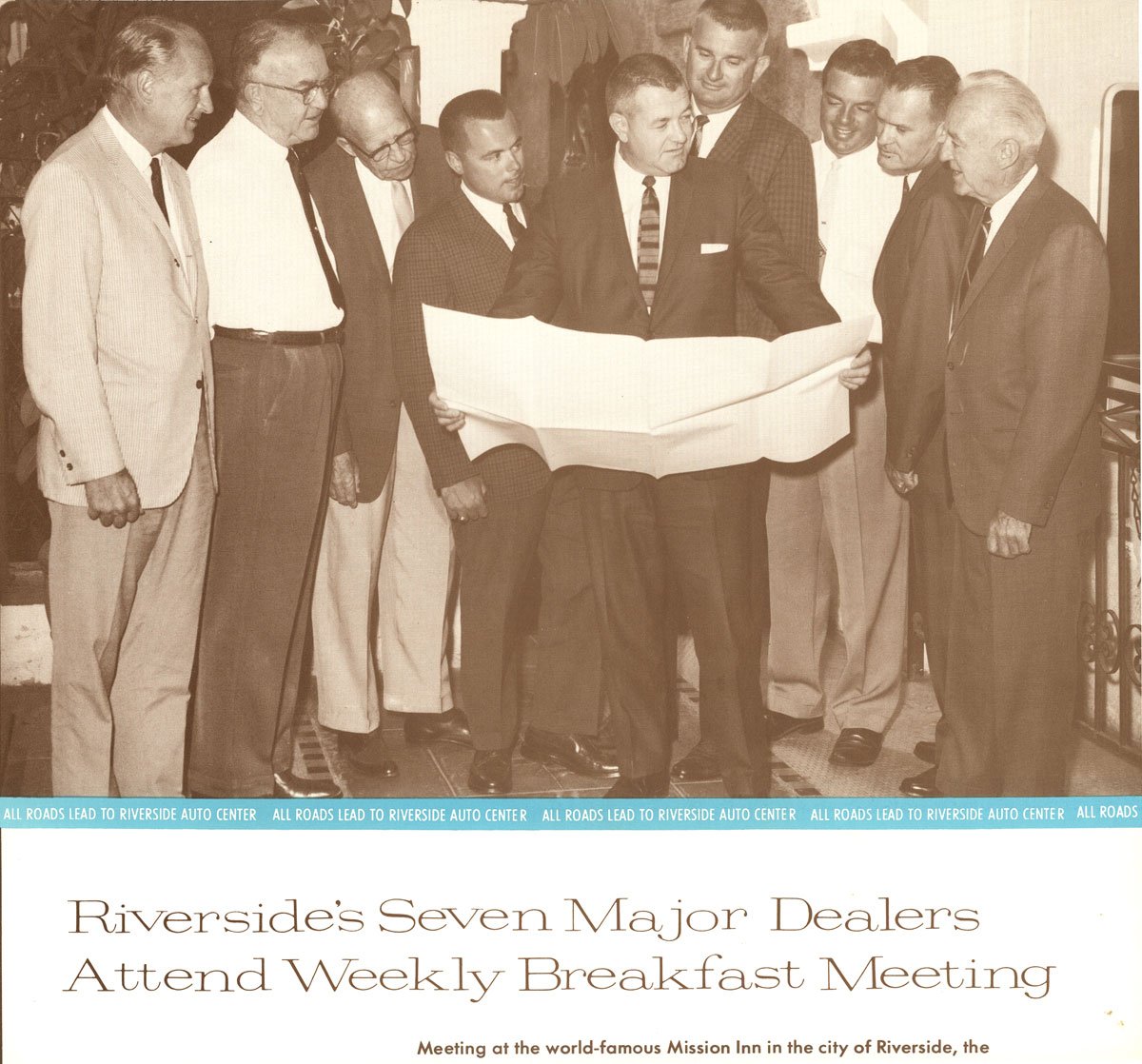
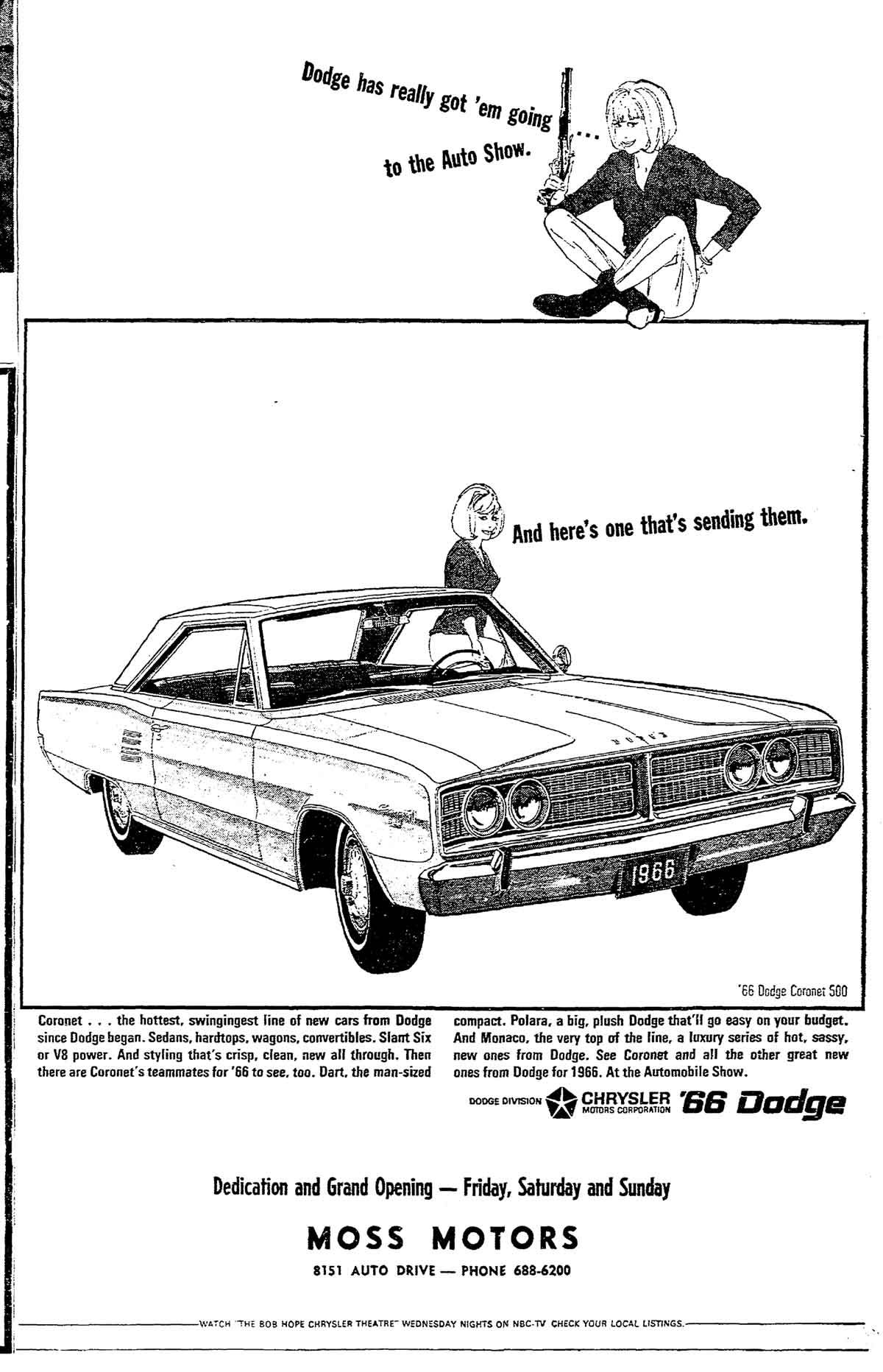
Reports vary, but the initial concept was conceived sometime between 1953 and 1958 by downtown Riverside car dealers. It’s believed the concept gained steam from three dealers in particular: George Reade Sr. (Chevrolet), Charles W. “Bud” Dutton Sr. (Cadillac/Oldsmobile), and Julian Adrian “Red” Moss Sr. (Dodge).
The impetus for the shared car dealer center was the need for larger facilities to replace their cramped downtown locations, which were mostly along Market Street north of Seventh Street (Mission Inn Avenue):
“It became apparent in the late 1950s and early 1960s that many of the downtown dealers (most of them clustered on Market Street) were outgrowing their facilities and didn’t have room to expand,” (George “Cap”) Reade (Jr.) explained. “The idea to relocate jointly was promoted by my father (also George Reade, and also, before his death, president of De Anza Chevrolet). He was a prime mover for some time.”
Riverside Press-Enterprise – September 20, 1976
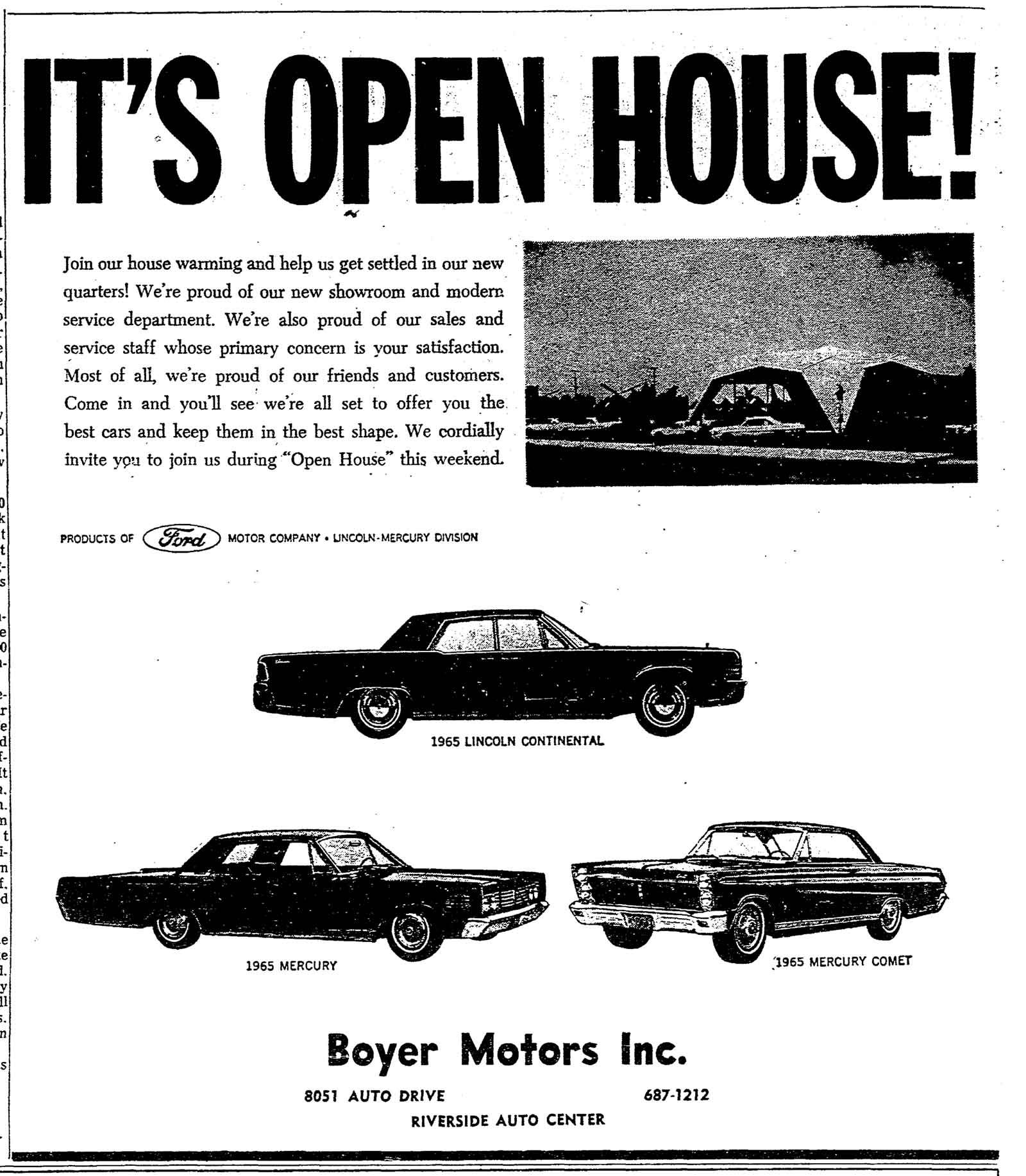
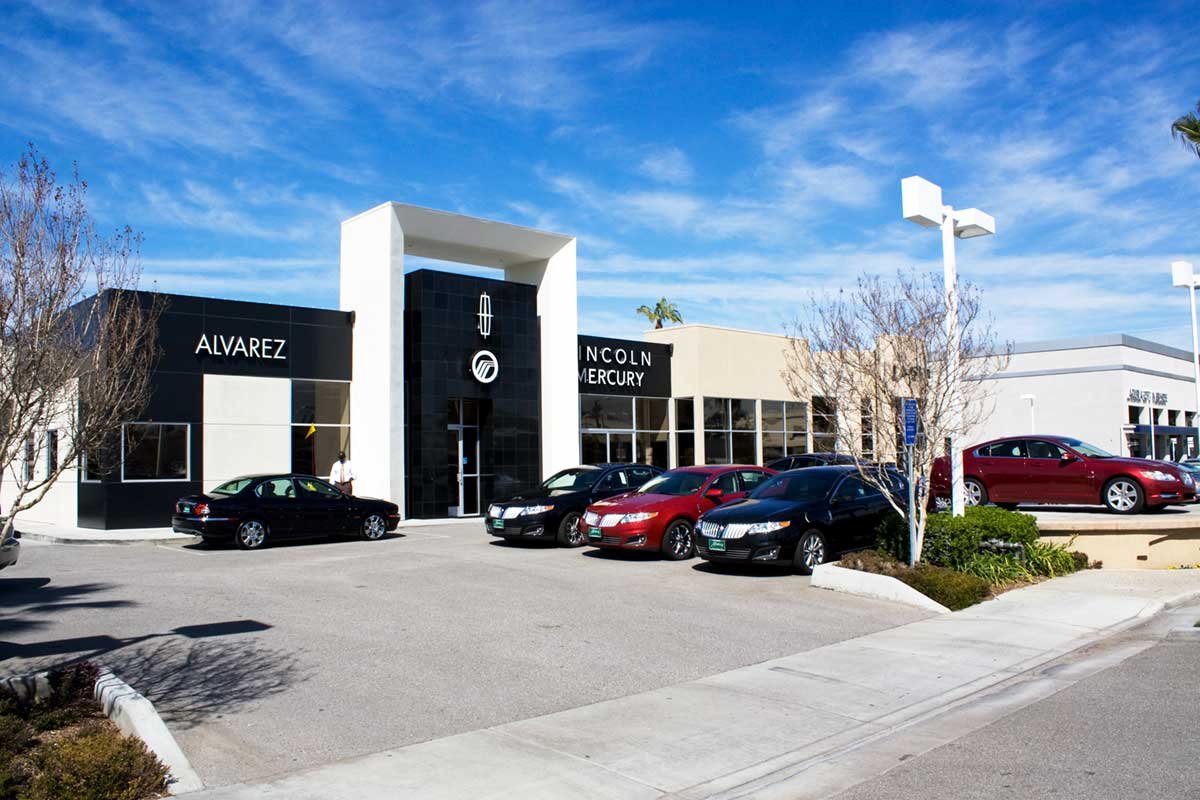
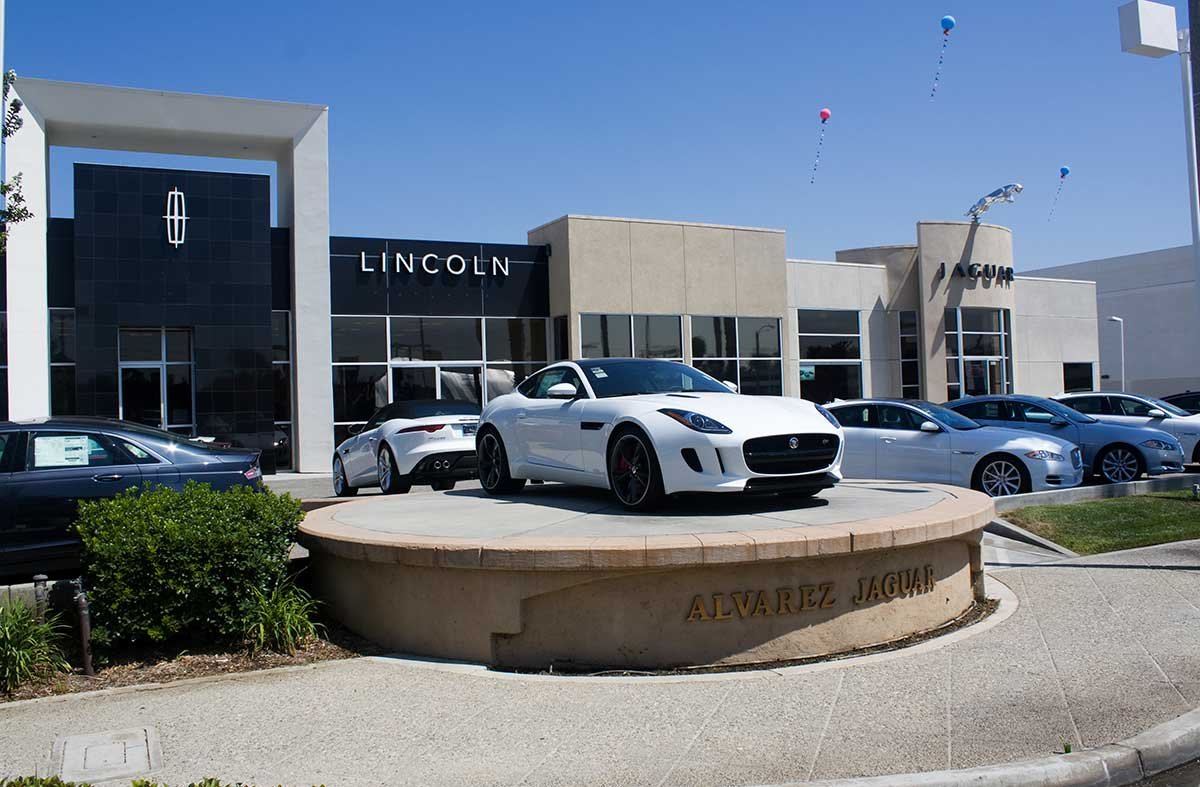
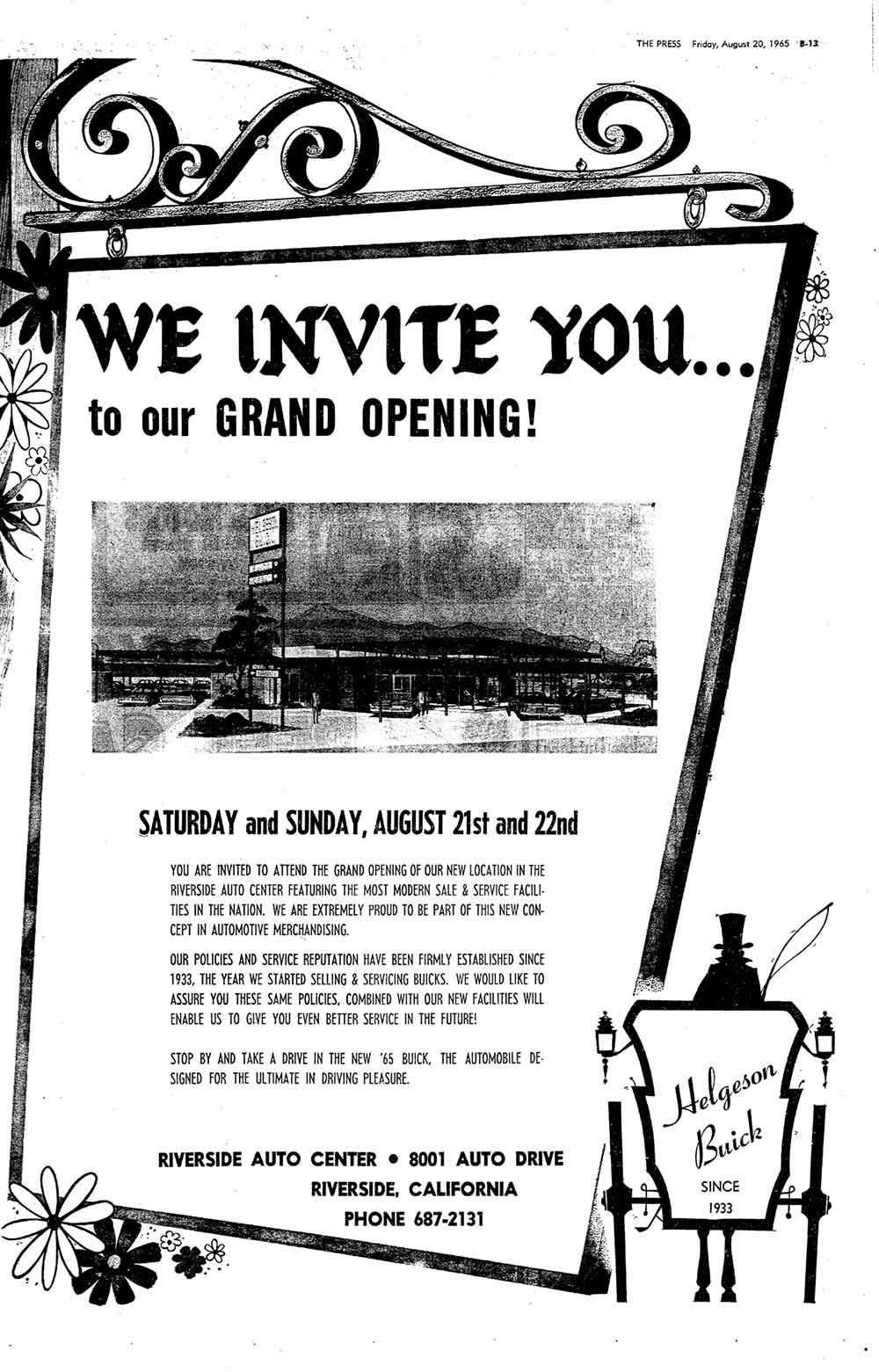
By the time of initial proposal in November 1961, four other downtown dealers – Warren-Anderson (Ford), Helgeson (Buick), Boyer Motors (Lincoln-Mercury), and Gilmore (Pontiac) – had also committed to the concept, bringing the total to seven dealers in the founding auto center group.
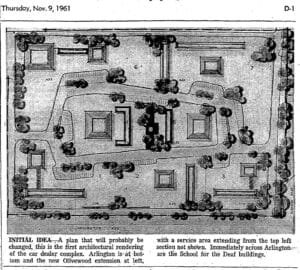
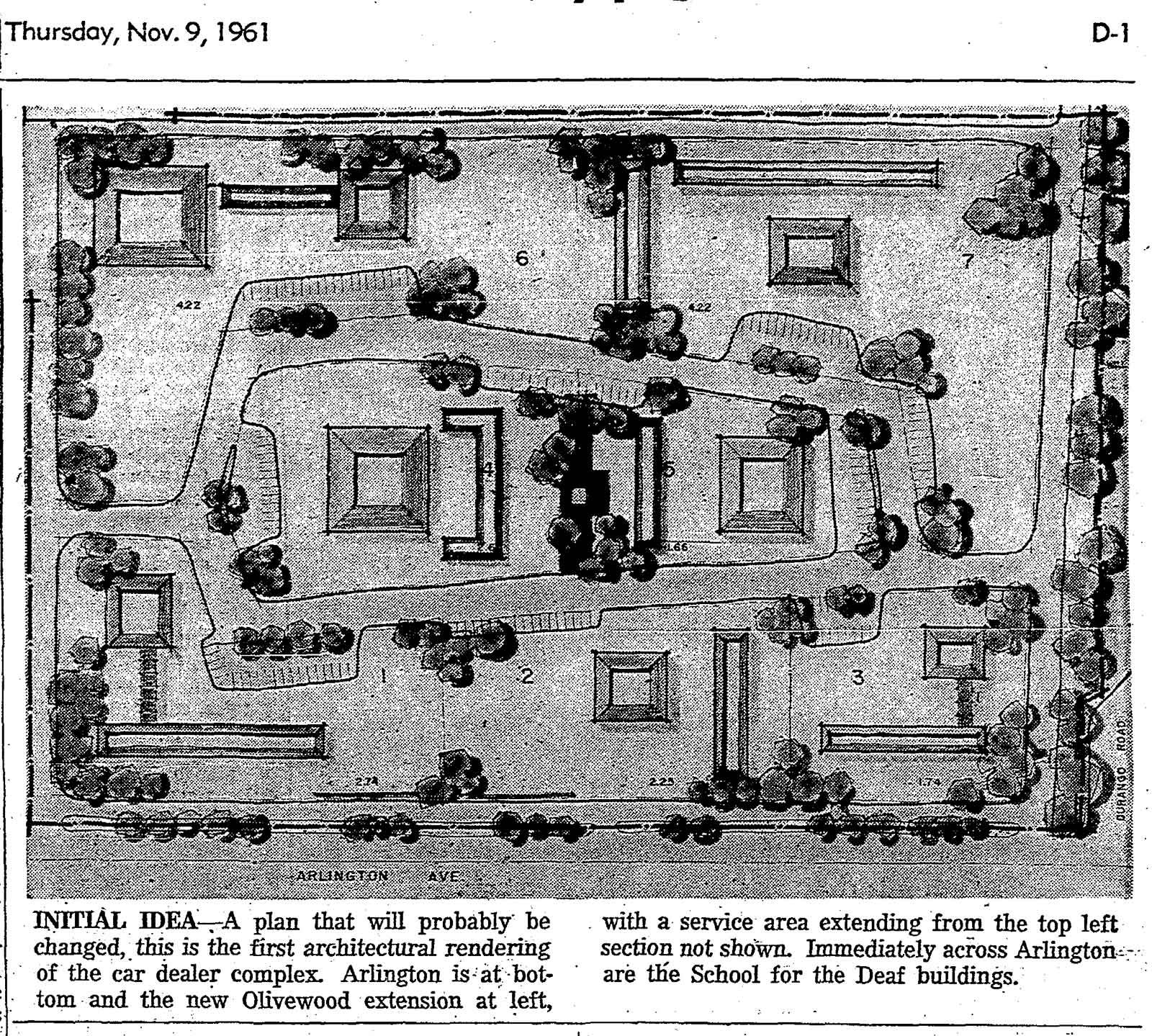
Originally, the group proposed construction of a “Riverside Automotive Park” on approximately 30 acres they had assembled and purchased on the north side of Arlington Avenue between McMahon and Durango streets (essentially where Target is today, across from CSDR). However, this site was scuttled following nearby residential opposition, leading to a voter-approved referendum in June 1962 that rescinded the zoning change made by the City that had allowed the center.
Perhaps this was fortunate, dealers say, because there would not have been enough room at that (Arlington Avenue) location for all of them to operate comfortably.
Riverside Press-Enterprise – November 29, 1968
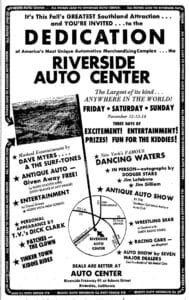
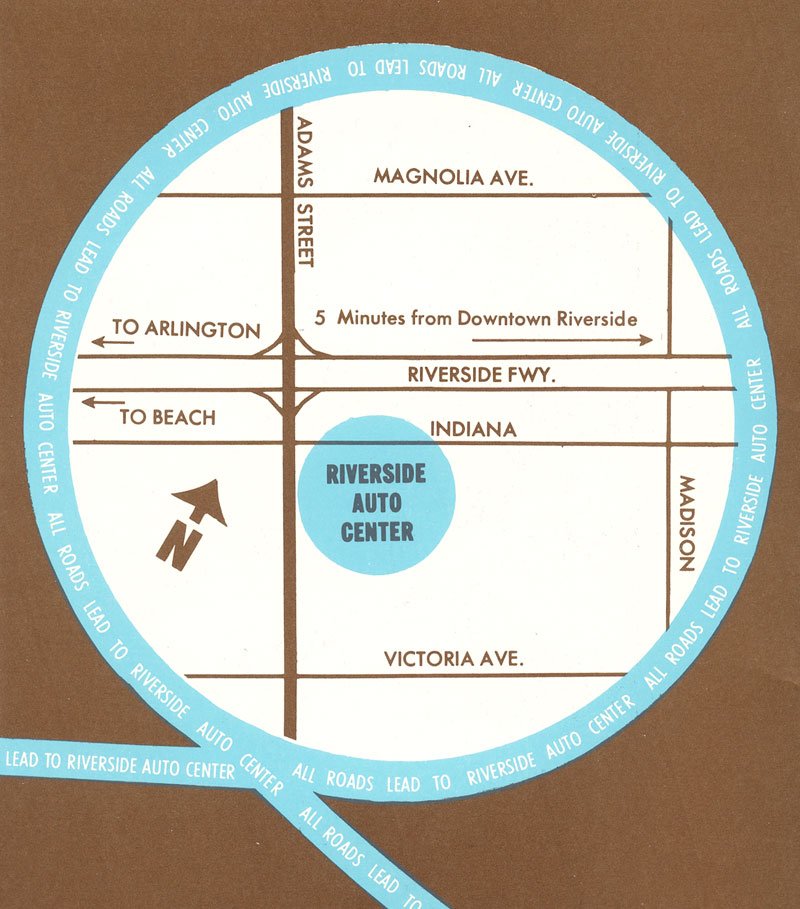
Thus, what initially appeared to be a setback ended up being a blessing in disguise. With some assistance from the City (not wanting sales tax revenue to be lost to a nearby community), a larger site was found just off the Riverside (91) Freeway at Adams Street. The new site – nearly double the size of the Arlington location (55 acres versus 30 acres) – offered better freeway visibility. But moreover, it allowed for larger dealer lots, bigger showrooms, expanded service centers, and room for related peripheral dealers/services.
Initially given tacit approval by the Big Three automakers in Detroit, the development garnered national press in Businessweek (currently Bloomberg Businessweek) on the eve of its opening. And although it initially only included domestic car dealers, foreign dealers would soon join, adding to the already revolutionary car-buying experience.
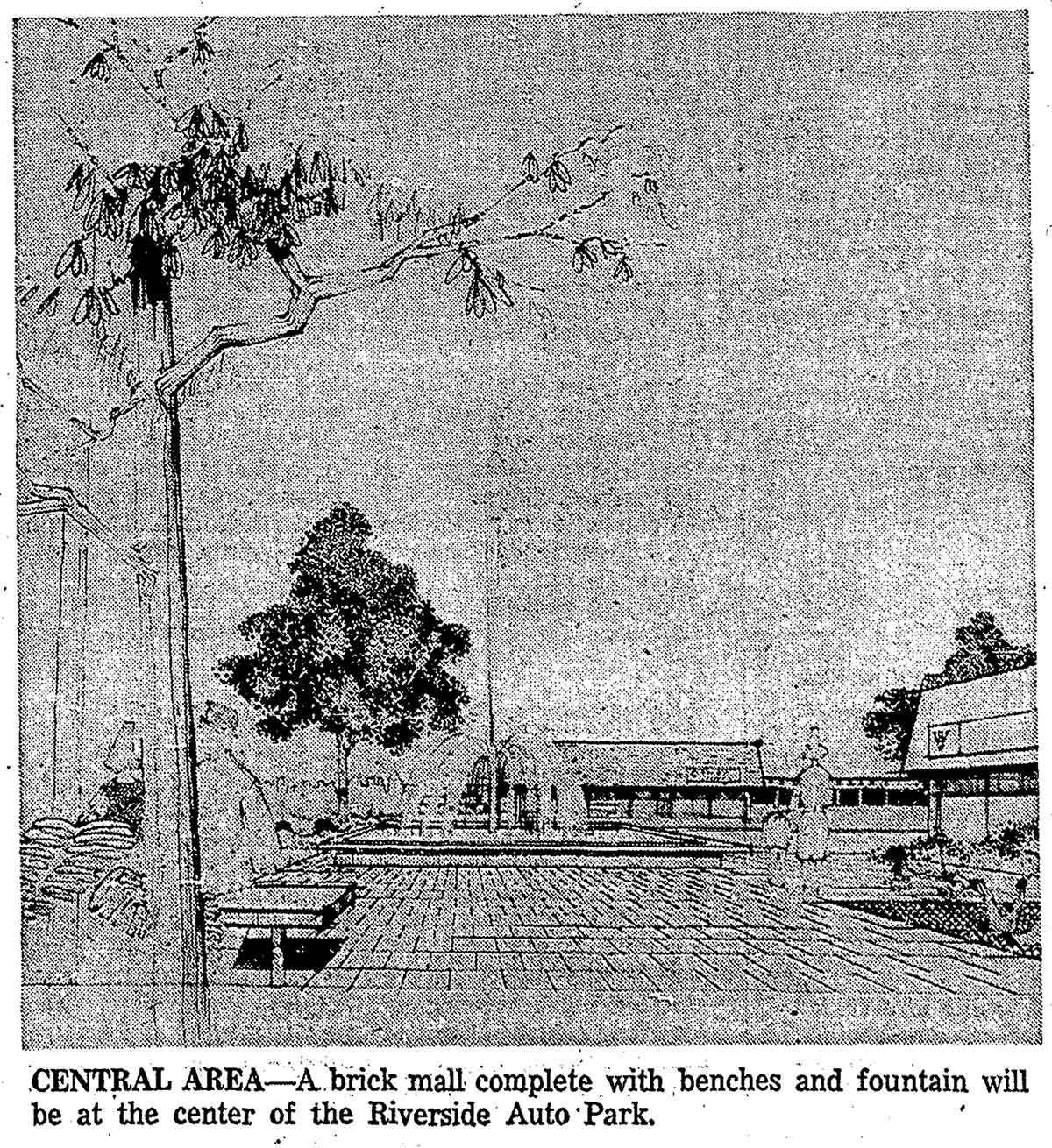
The one aspect of the new concept that fizzled, however, was a small shopping center comprised of both auto and non-auto uses that was planned for the central parcel. A bank, restaurant, liquor store, barber shop, beauty salon, dry cleaners, insurance agency, and a few auto-related entities (AutoLab Diagnostics/Car Wash, J&M Speed Center, plus tire and glass shops), opened and operated at various times. But the larger shopping center never fully materialized as envisioned, and the area has mostly been absorbed into dealer uses (though a few non-dealer entities remain, including Effortless Motors, which has customized a handful of vehicles for former Los Angeles Lakers center, Shaquille O’Neal).
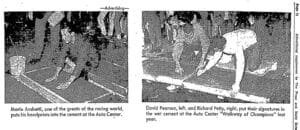
One other interesting – and likely long forgotten – feature that apparently also lost steam was the Riverside Auto Center’s “Walkway of Champions.” For five years beginning in late 1965, at least 10 drivers – as they appeared in town for races at the legendary Riverside International Raceway – were immortalized in cement, much like at Grauman’s Chinese Theater in Los Angeles. The drivers were: Dan Gurney, Parnelli Jones, Mario Andretti, Richard Petty, Cale Yarborough, David Pearson, Jackie Stewart, Skip Hudson, Graham Hill, and Jimmie Clark.
It’s unclear exactly where these signed cement imprints were located. But according to a 1966 Press-Enterprise article, some may have been placed near De Anza Chevrolet. However, a 1970 advertising map for the Auto Center indicated they were located in planters along the sidewalk on the south side of Auto Center Drive between De Anza Chevrolet (currently Riverside) and Warren-Anderson Ford (currently Fritts), apparently to be part of the unfulfilled shopping center. It’s also unclear what happened to the slabs that, if not already gone, were likely removed during a late-1990s renovation.
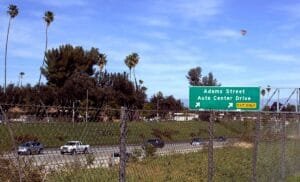
In 1987, exit signage for the Riverside (91) Freeway was changed following the addition of “Auto Center Drive” to a short portion of Adams Street. And in 1990, the City created the “Auto Center Specific Plan,” which brought about the circa 1993 freeway-adjacent Riverside Auto Center messaging sign and eventually led to major renovations by the end of the decade that included uniform dealer signage and lighting, entry monuments, angled parking, new sidewalks and landscaping, rotary intersections, and vehicle display pods.
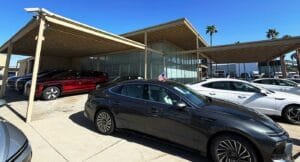
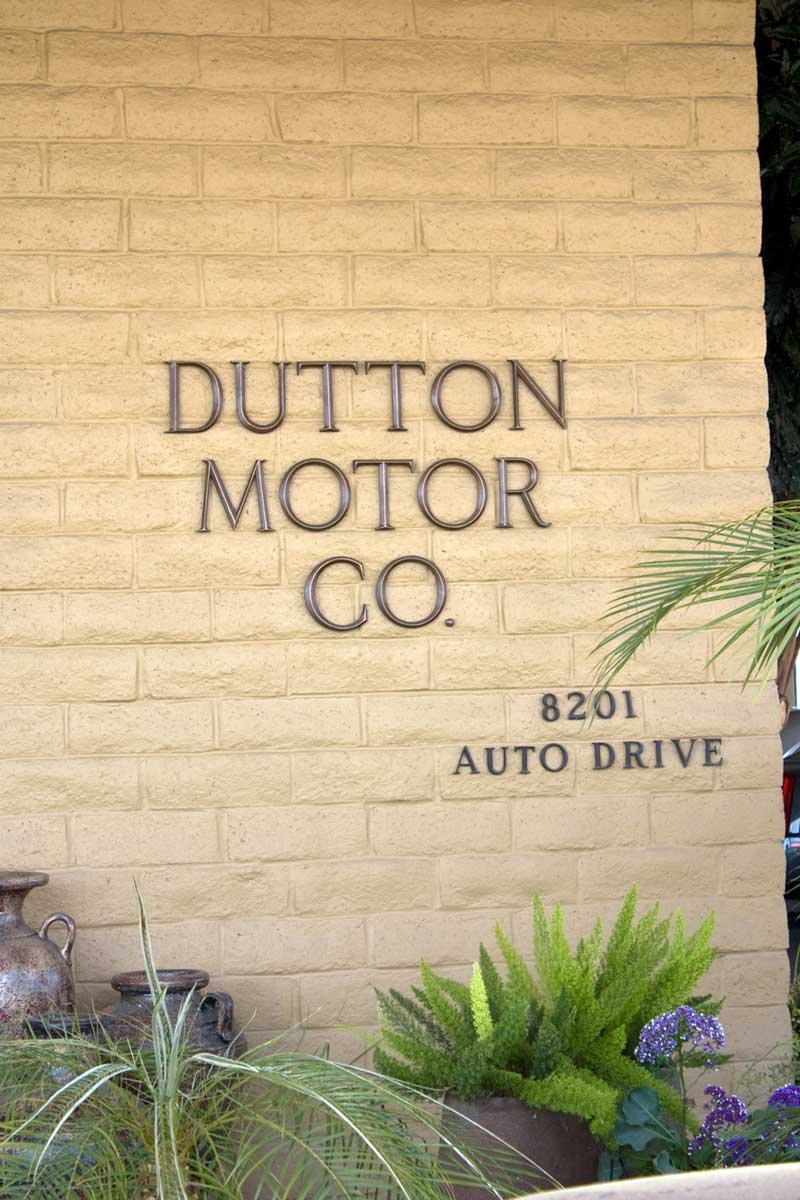
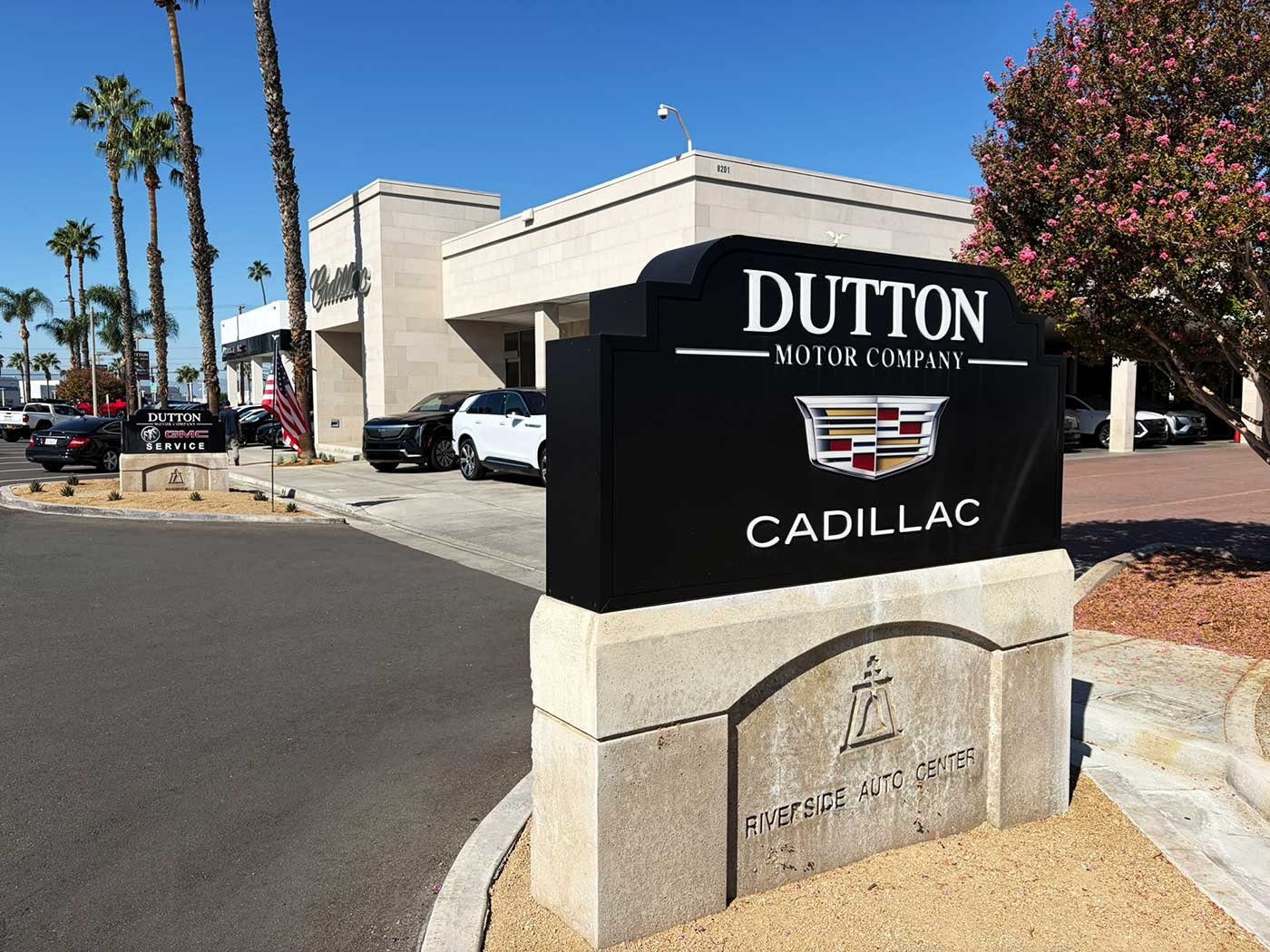
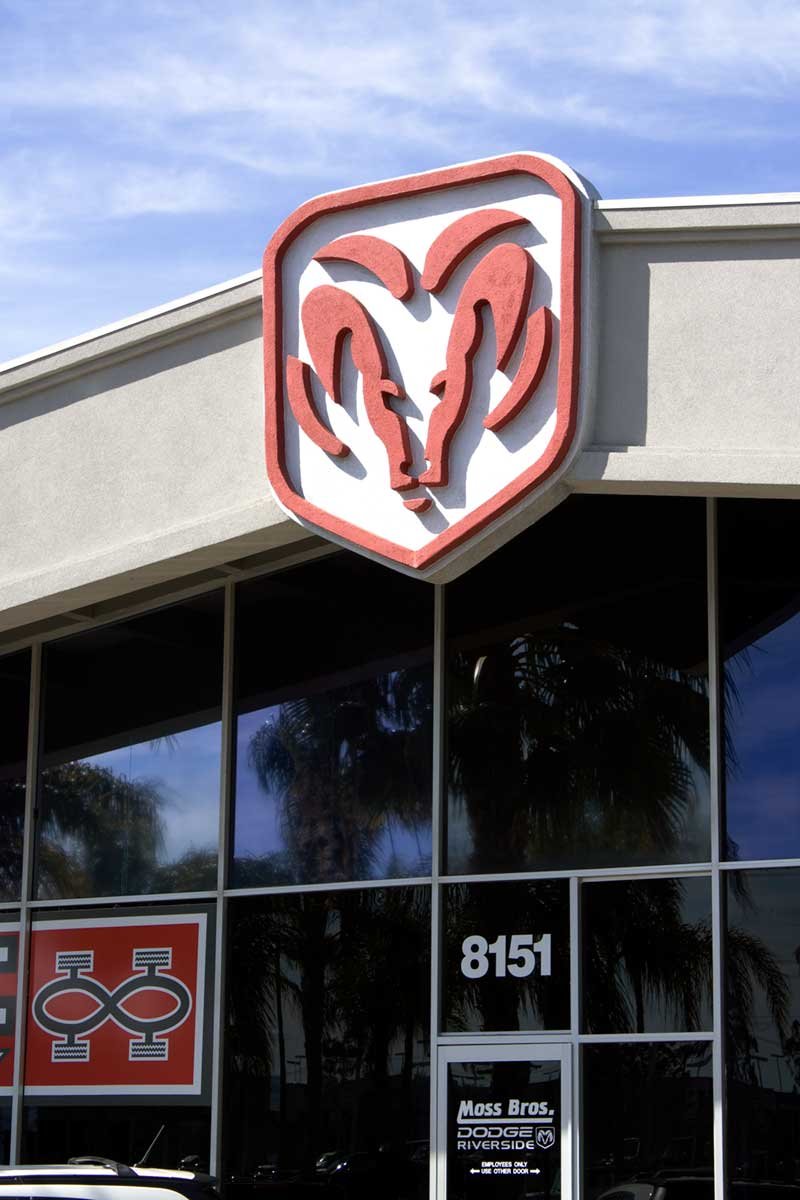
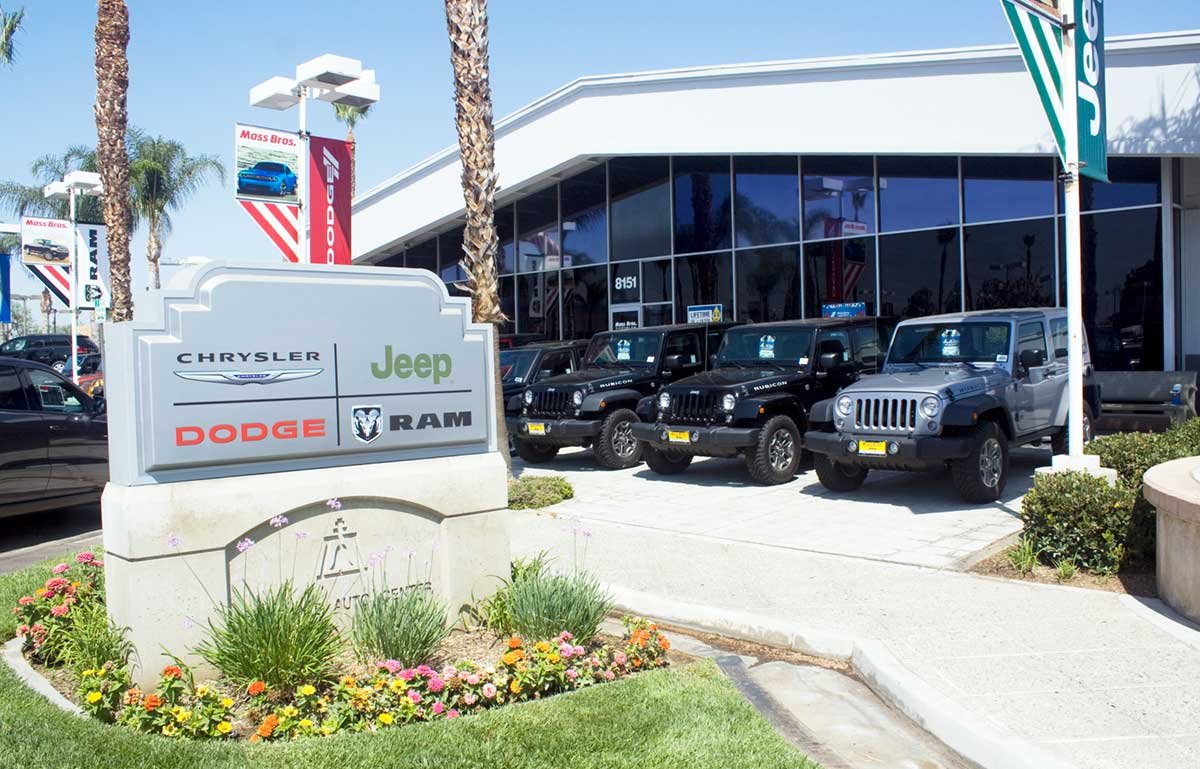
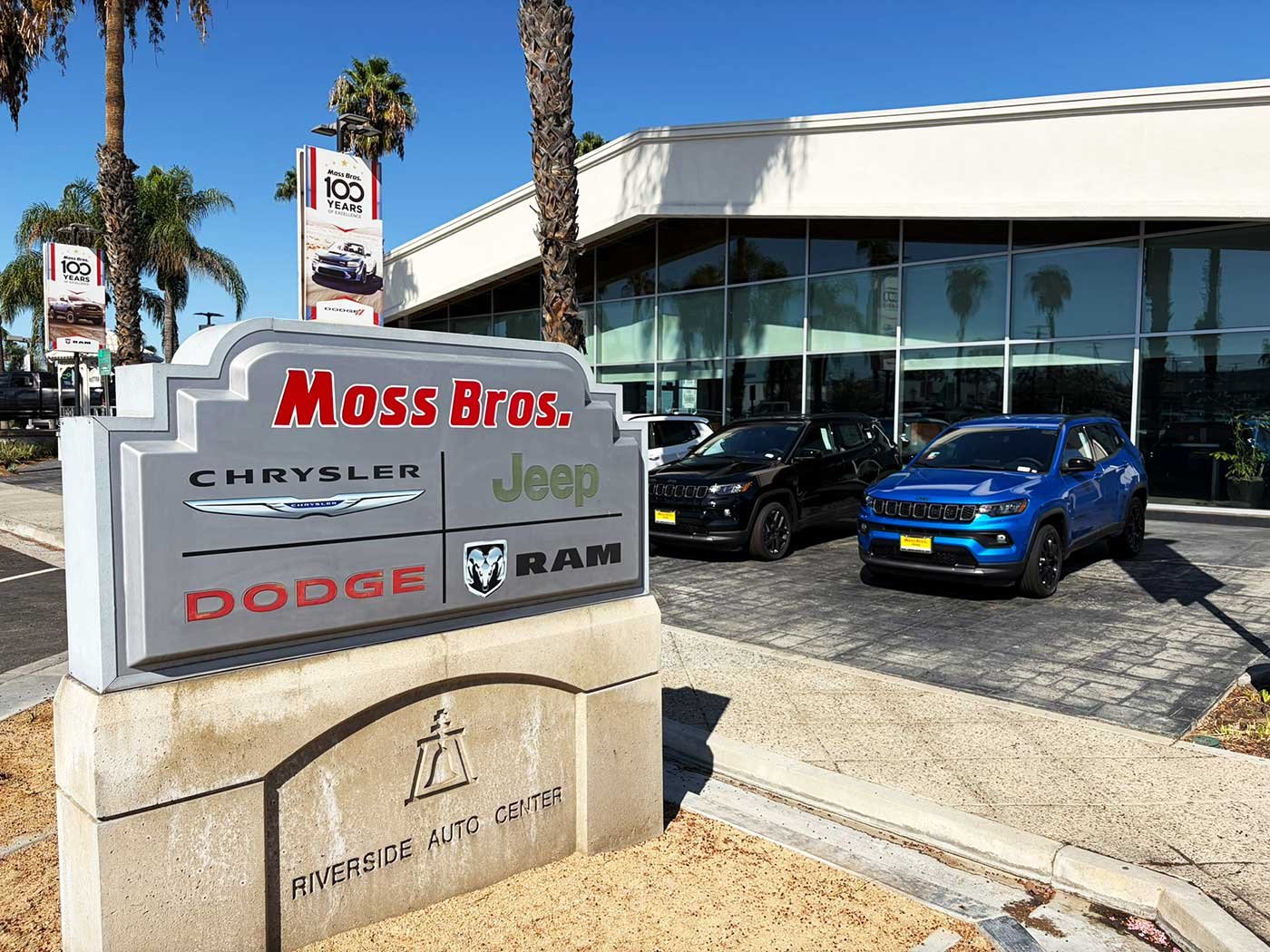
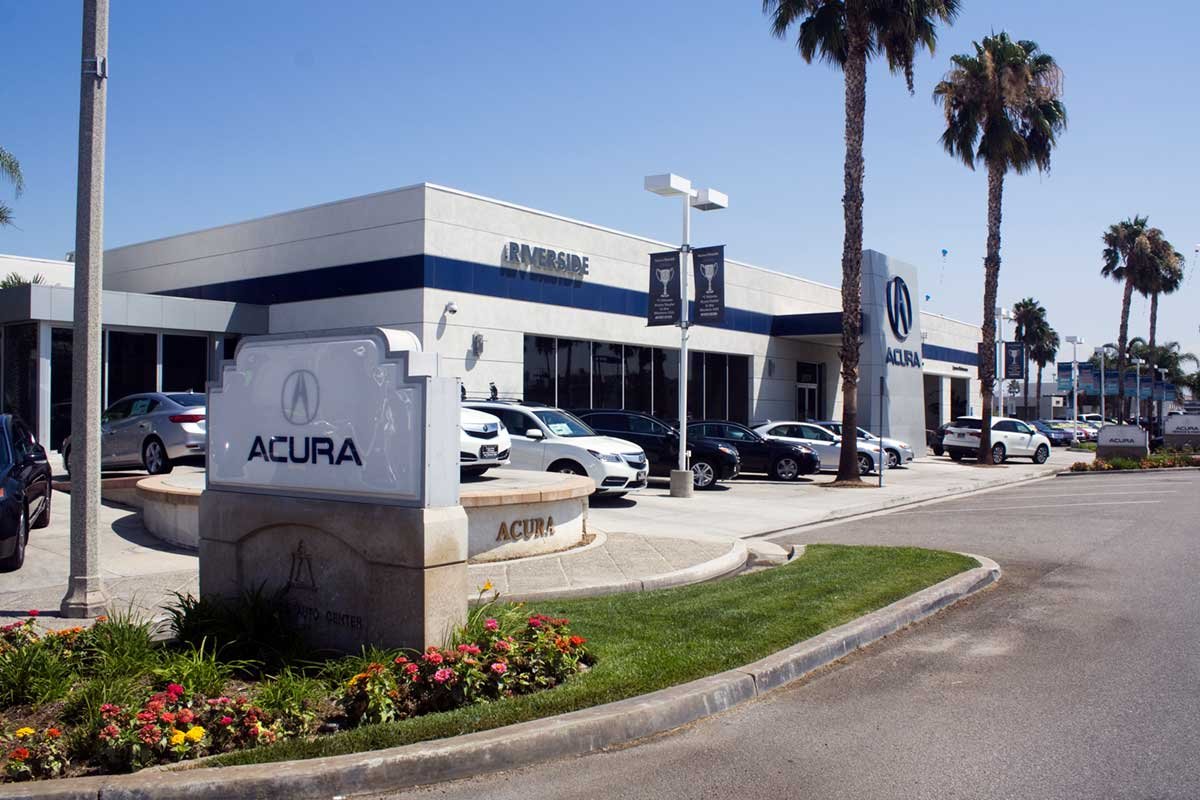
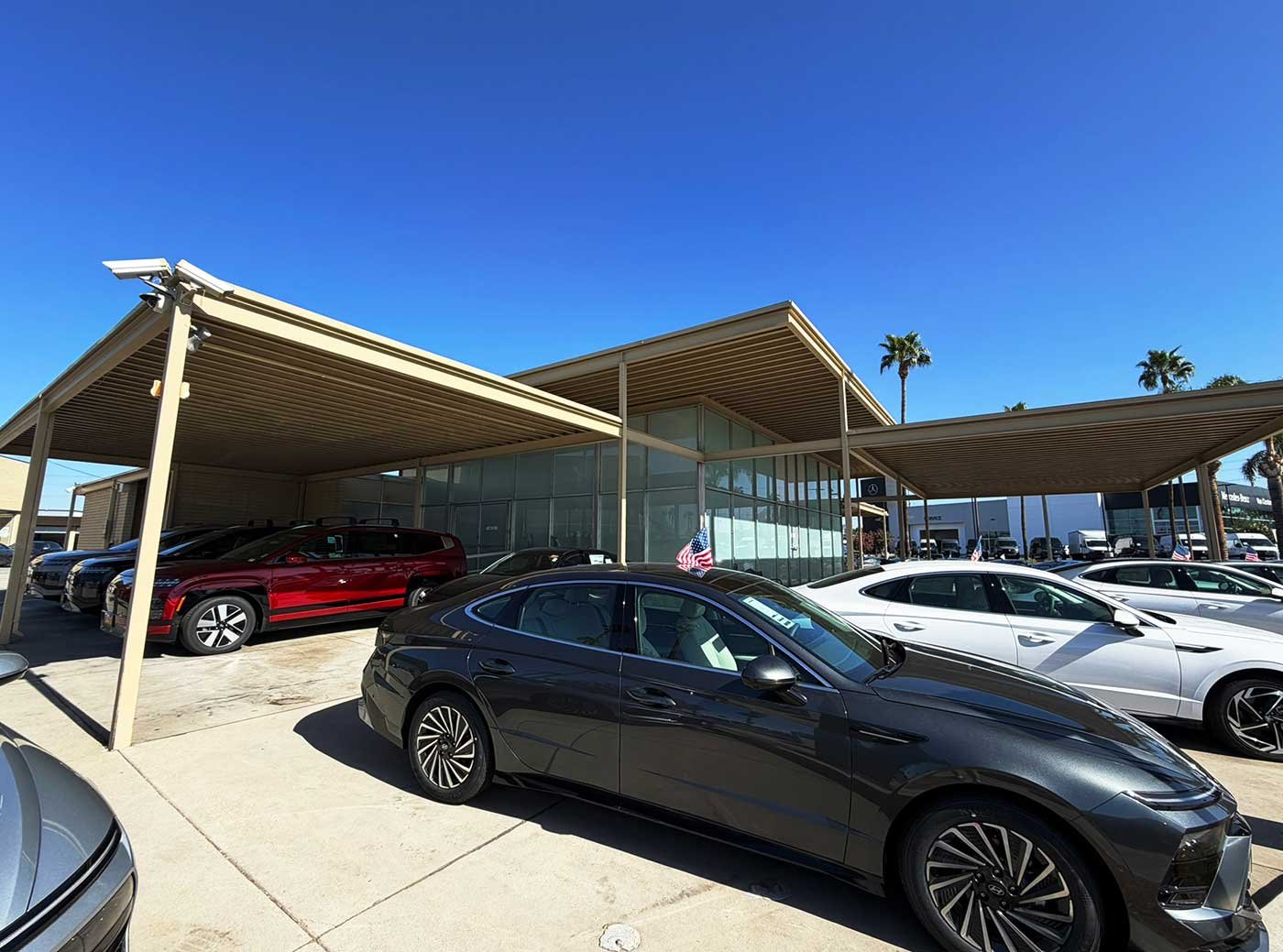
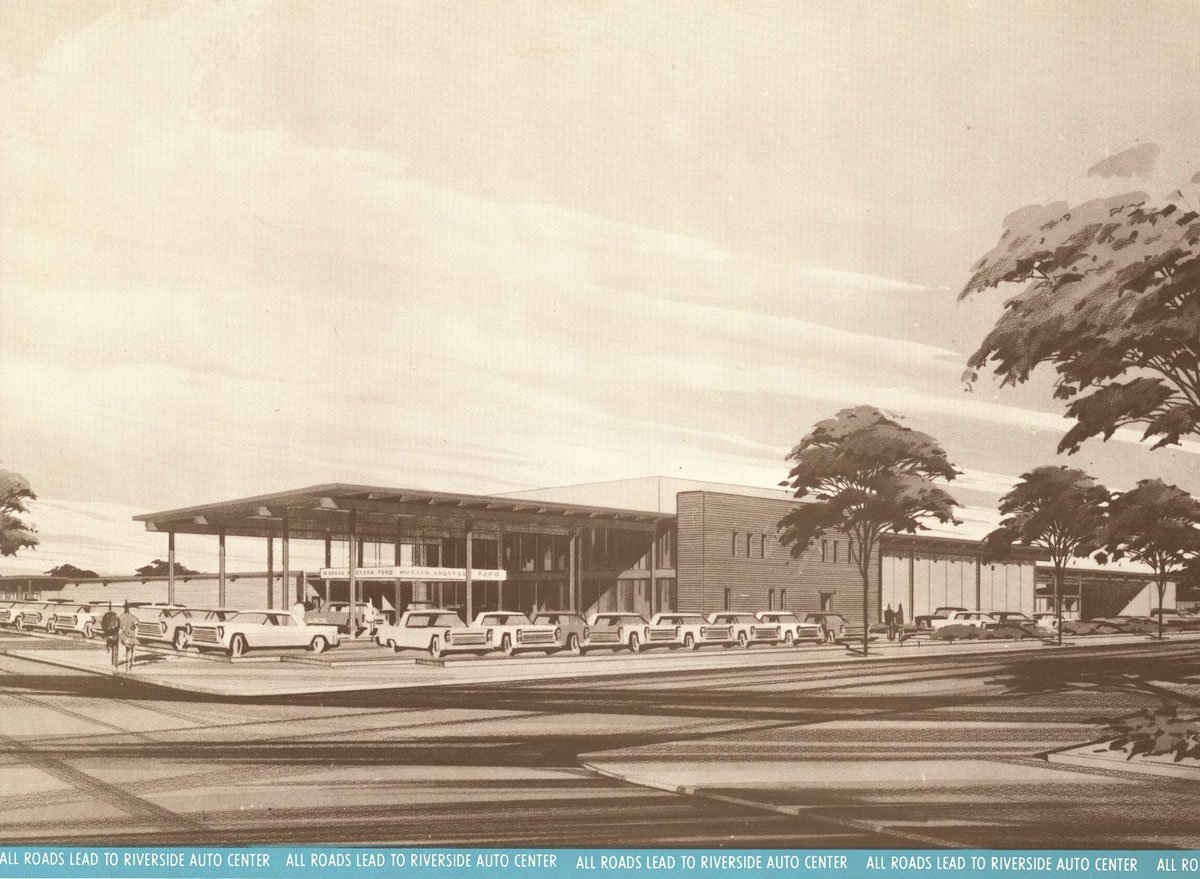
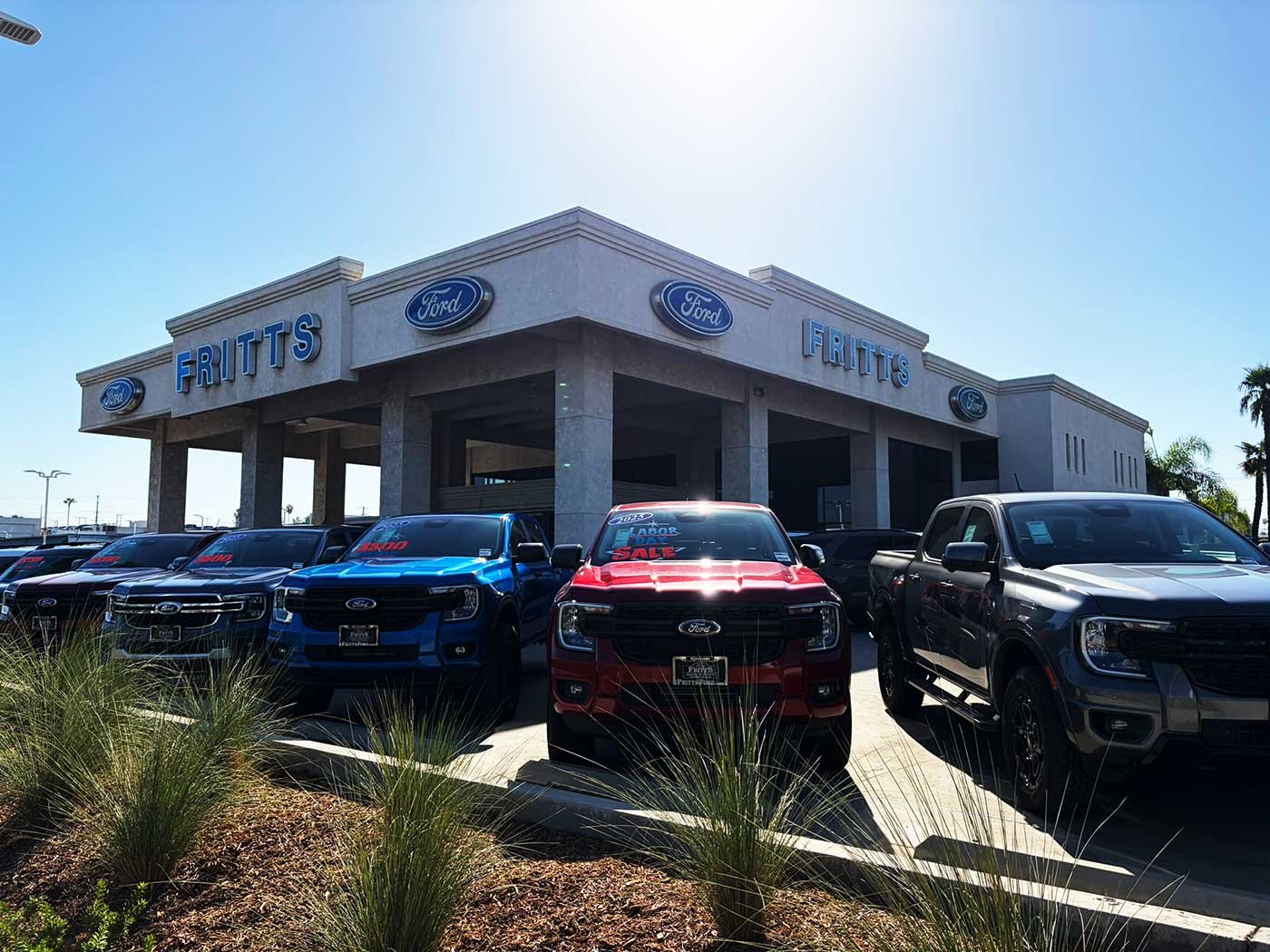
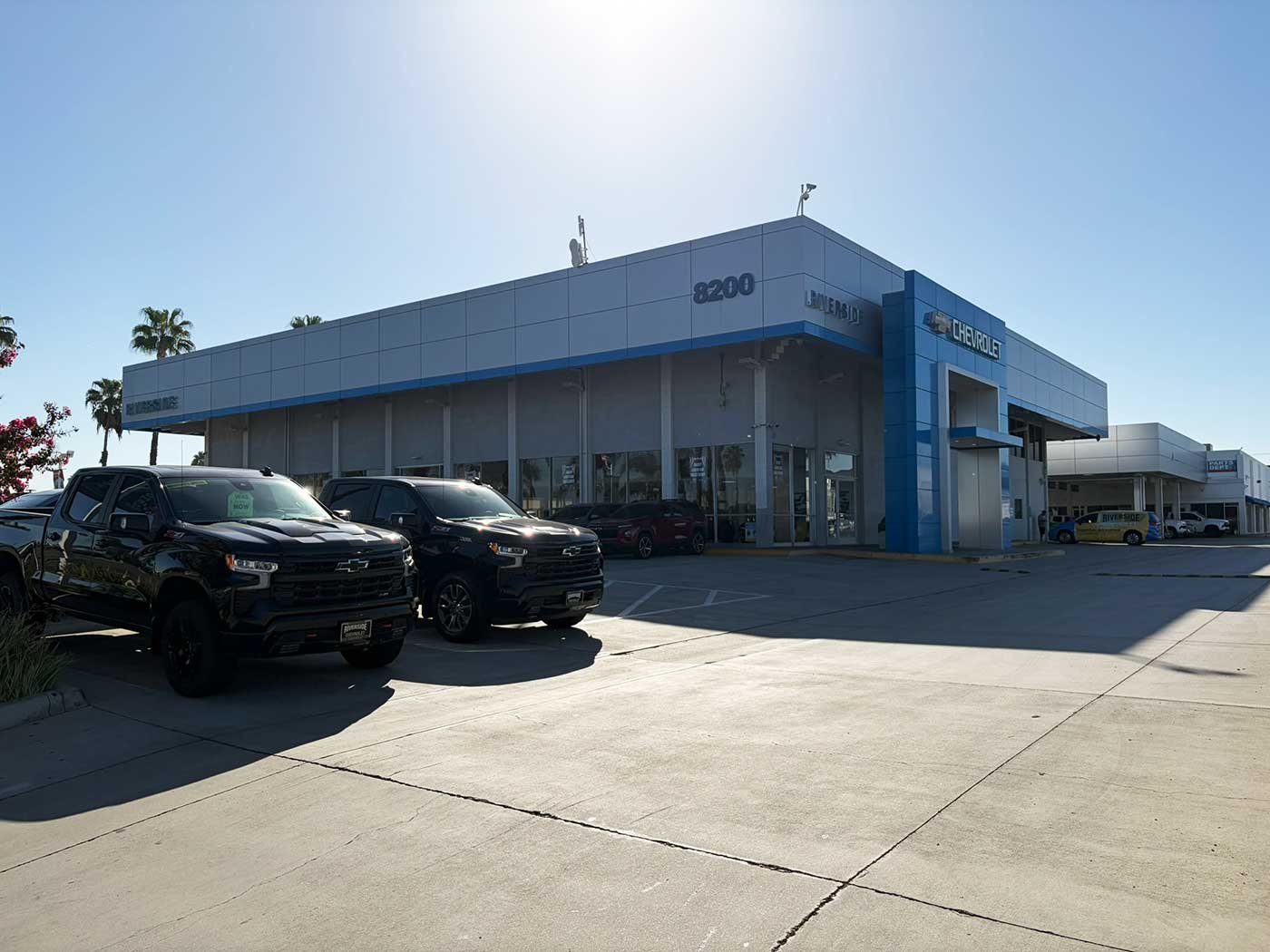
In addition, every showroom of the original seven dealers has been renovated. Three have received moderate updates but essentially retain their mostly-original structures (Moss Motors/Bros. Dodge/Ram, De Anza/Riverside Chevrolet, Warren-Anderson/Fritts Ford). One has been extensively remodeled (Rubidoux/Dutton Motors Cadillac/Buick/GMC). And two have been demolished and replaced (Kennedy/Gay Hood Pontiac, Boyer Motors Lincoln-Mercury). Only one original showroom remains relatively intact without any major apparent updates (Helgeson Buick). However, it’s now part of the Riverside Hyundai lot and is no longer used as a showroom.
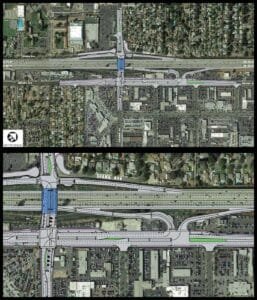
More recently, after several years of planning, a replacement bridge/interchange is finally forthcoming for Adams Street. (As a side note, the bridge was last expanded in 1965 just as the Auto Center opened.) An extensive, 380-page initial study/environmental assessment was completed in late 2023 and is currently going through final approval/funding. The plan shows a new, widened Adams Street bridge over the 91 Freeway. However, as part of the project, the eastbound ramps will be shifted eastward past the current/new bridge, becoming hook ramps at Indiana Avenue (approximately where Enterprise Rent-A-Car currently sits at 8155 Indiana Avenue). The $129 million project is expected to begin in 2028 with a two-year construction period.
Over the years, the Auto Center planning area has grown to approximately 150 acres, including the entirety of Indiana Avenue between Adams and Madison streets (with a few non-automotive uses), likely making it one of the largest such centers in the nation. In addition, the center has grown from the original seven dealers in 1965 to 22 major, new car dealers in 2026 with nearly every major brand and make present (with various defunct brands/dealers disappearing over the years). It has also attracted several secondary dealers (CarMax, DriveTime, Harley-Davidson, Malcolm Smith Motorsports, Enterprise, Hertz, etc.) and a handful of smaller dealers and related services.
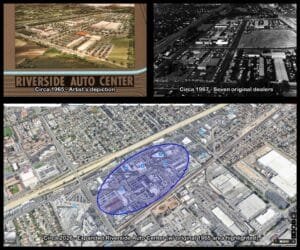
Now in its 61st year, the Riverside Auto Center certainly outperformed the initial expectations of the original seven dealers, and indeed, transformed the automotive buying landscape – not only across the nation, but elsewhere as well.
The Auto Center not only attracts local dealers, says (George “Cap”) Reade (Jr. of De Anza Chevrolet), but national and international curiosity. “This idea has been widely copied across the country. We’ve had people from half a dozen European countries, Japan, Australia, Canada, Mexico, and South American countries. Representatives from hundreds of communities have called or come to see us.”
Riverside Press-Enterprise – September 20, 1976
Riverside Auto Center
2026 – List of New Car Dealers
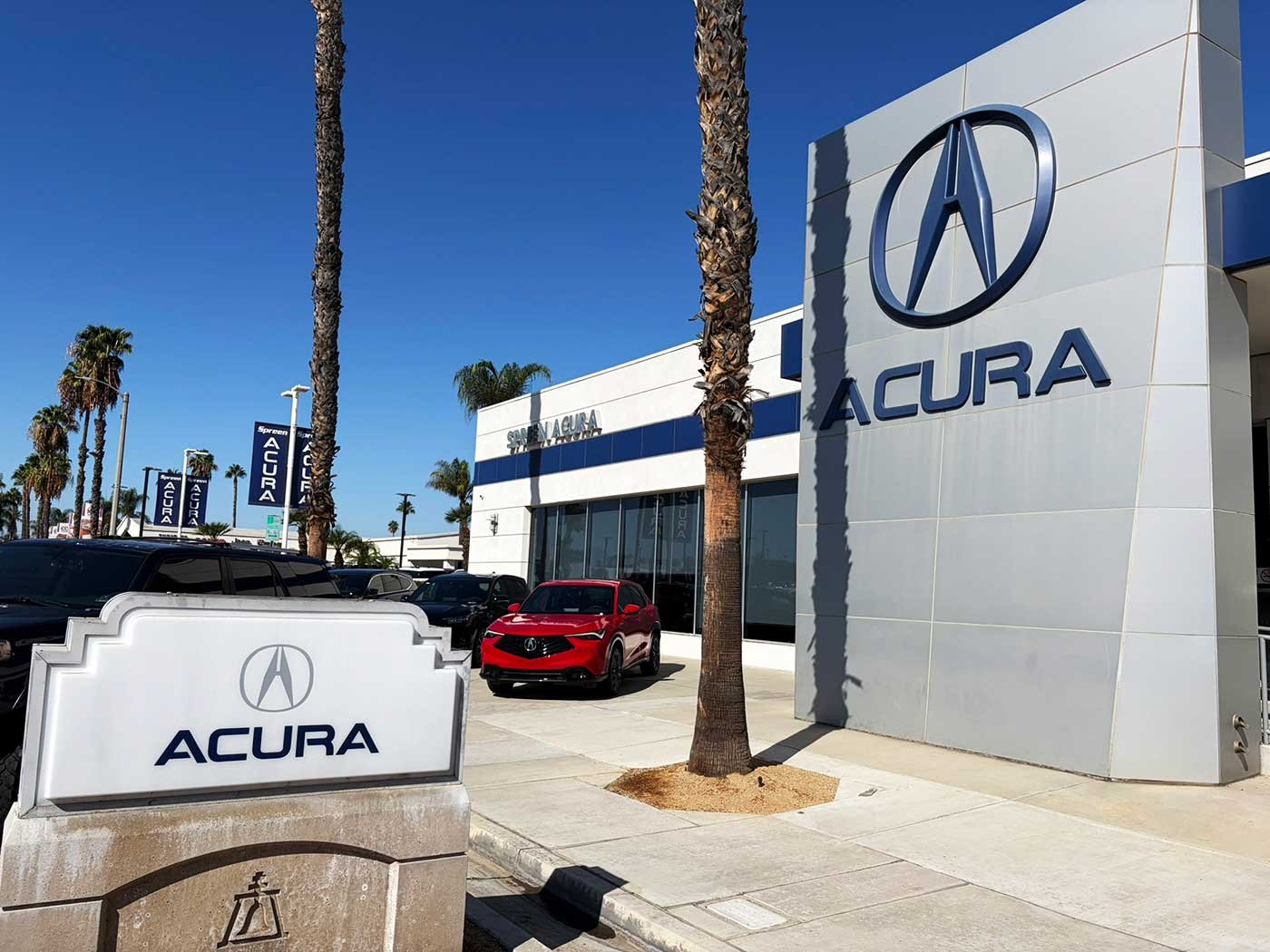
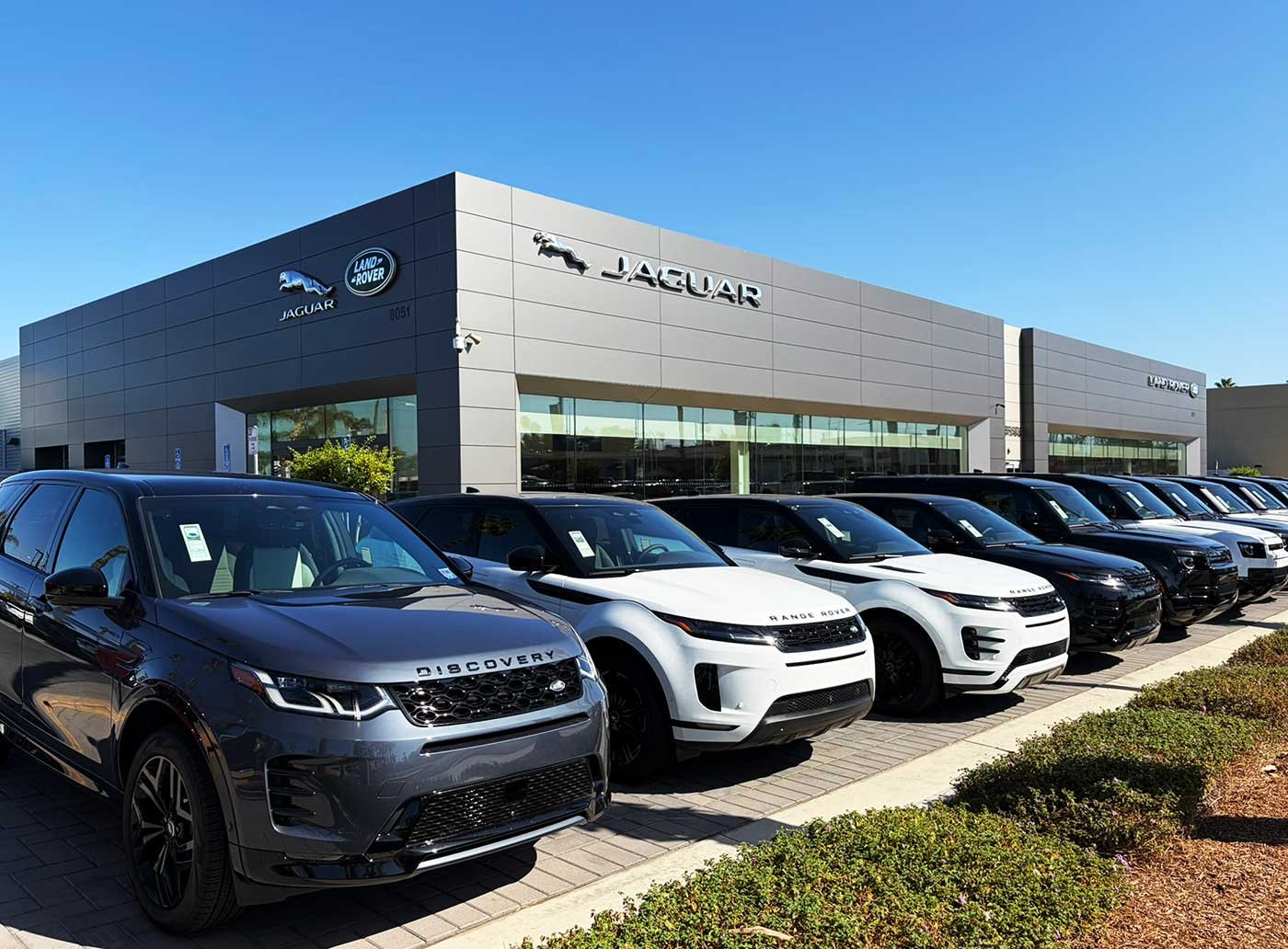
Spreen Acura, Audi Riverside, BMW of Riverside, Dutton Buick GMC, Dutton Cadillac, Riverside Chevrolet, Moss Bros. Chrysler Dodge Jeep RAM Riverside, Fritts Ford, Riverside Honda, Riverside Hyundai, Jaguar Riverside, Riverside Kia, Land Rover Riverside, Lexus of Riverside, Riverside Mazda, Walter’s Mercedes-Benz of Riverside, Walter’s Mercedes-Benz Sprinter of Riverside, Riverside Nissan, Porsche Riverside, DCH Subaru of Riverside, Toyota of Riverside, Riverside Volkswagen
Note: Does not include peripheral dealers/services
Source: Riverside Auto Center website
Related
- RaincrossSquare – Riverside Auto Center nearing 50 years (June 2014)
- Riverside Auto Center
- YouTube – Effortless Motors
Riverside Auto Center – Seven Original Dealers

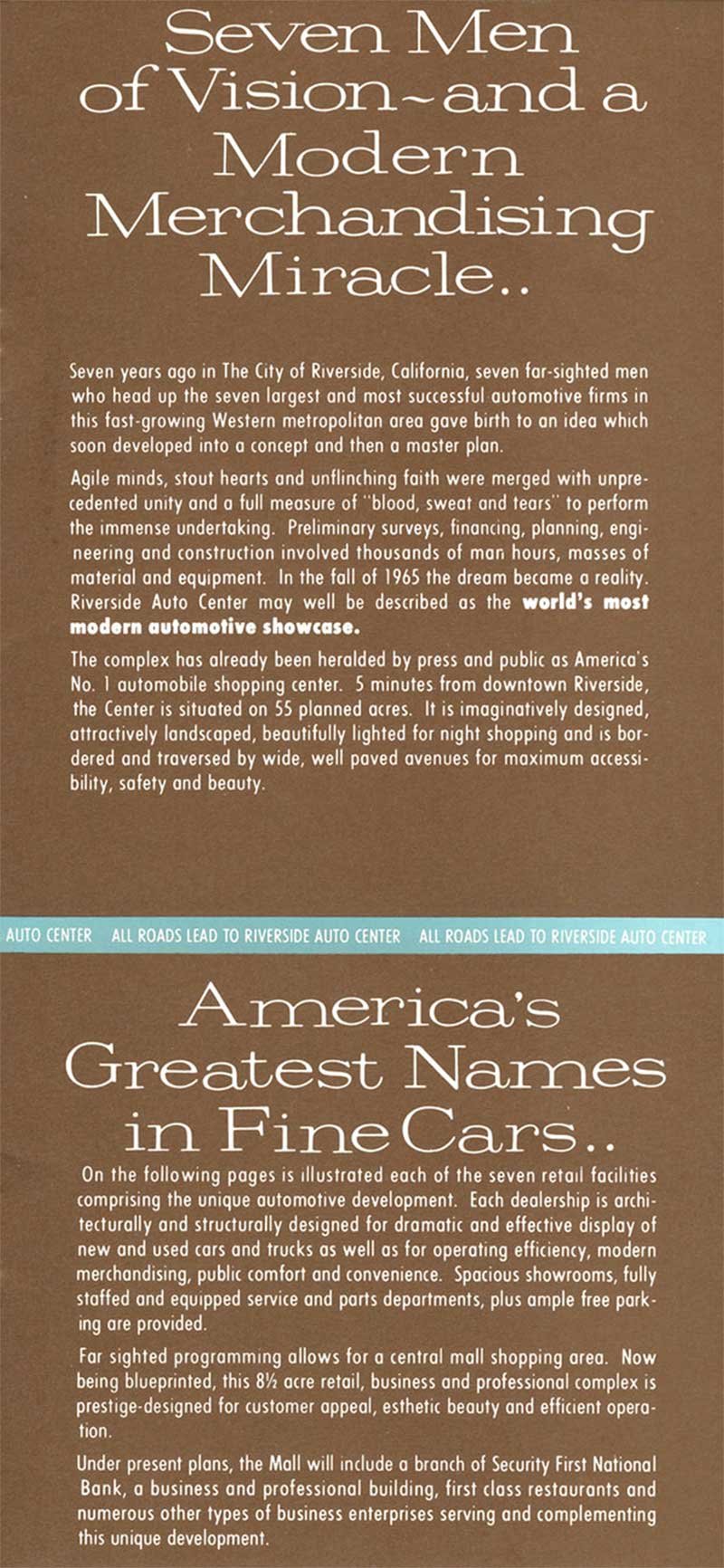
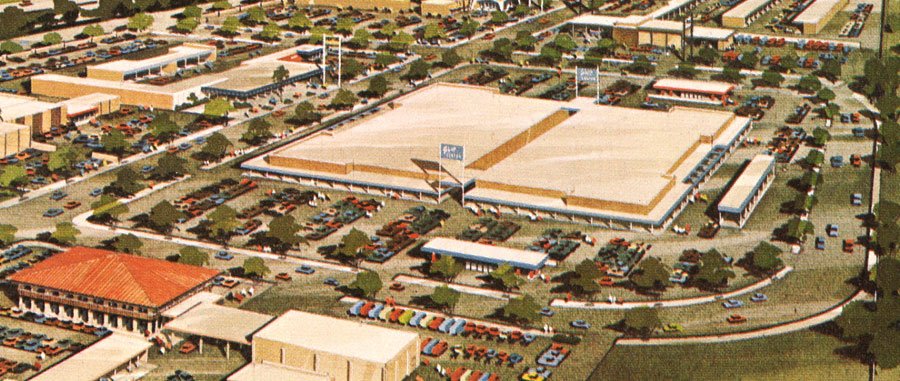

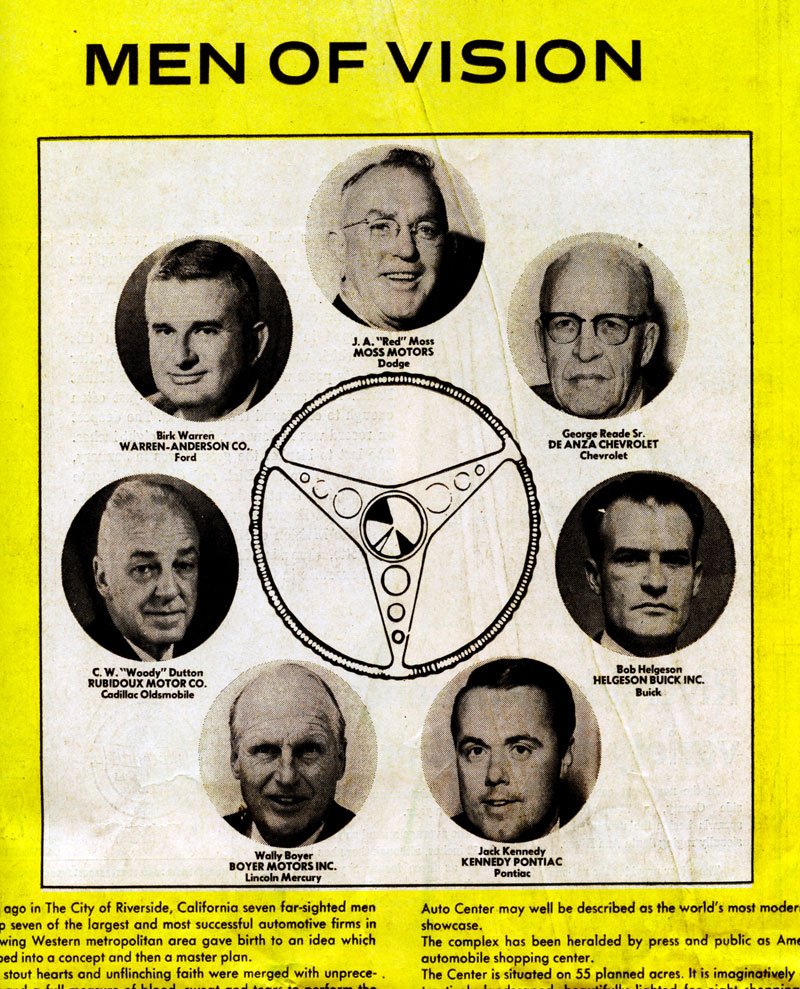
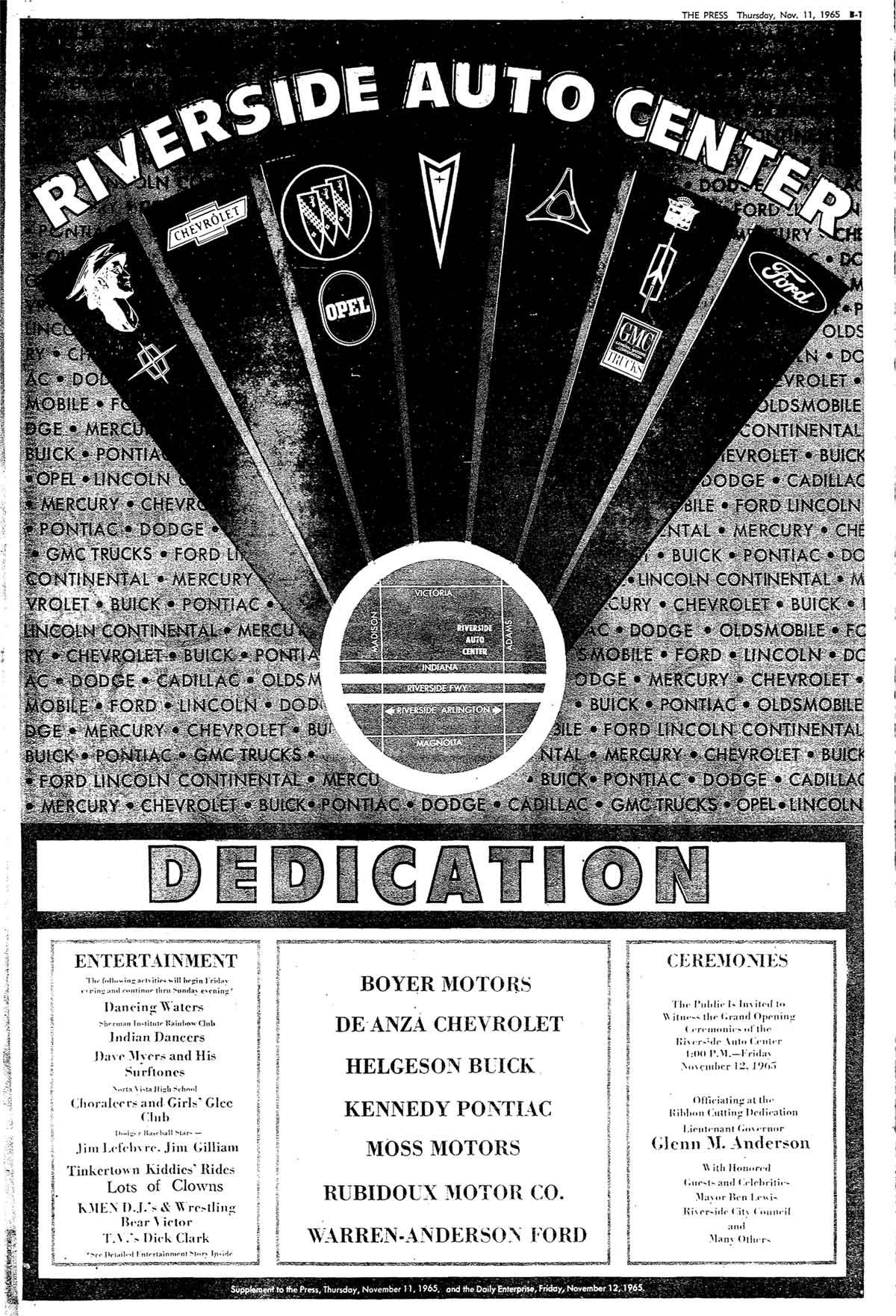













Sources: Riverside Press-Enterprise (DE19611109, DE19620604, DE19620606, DE19620608, PE19650711, RP19650728, RP19651023, DE19651028, DE19651029, PE19651111, PE19660814, RP19660814, DE19661029, RP19681129, PE19700115, DE19700731, RP19750710, RP19760920, PE19870204, PE19900824, PE19900926, PE19910621, PE19910821, PE19930624, PE19930825, PE19950607, PE19960728, PE19961027, PE19980517, PE19980520, PE19990127, PE20001207, PE20010214, PE20130728, PE20240522); San Mateo (California) Times (SMT19650914); Banning (California) Record (BANREC19651027); Lamar (Missouri) Daily Democrat (LAMDD19651106); Los Angeles Harold-Examiner (LAHEX19651205); Raincross Gazette (RG20250911); USA Today (20260819); City of Riverside: “Riverside Auto Center Specific Plan” (adopted October 1990 including future additions/revisions); Caltrans/City of Riverside: SR91/Adams Street Interchange Project – Initial Study/Environmental Assessment (v2-Signed-01/16/2024); RoadAndTrack.com (20250903); NBCChicago.com – WMAQ-TV (20250929); RiversideAutoCenter.com; RaincrossSquare.com
2026 PAGE UPDATE: Added Business Week excerpt