
Sales tax wars
Interesting article recently in The Press-Enterprise regarding what is commonly referred to as “the fiscalization of land” by city and/or county jurisdictions.

Since the passage of Proposition 13 in 1978, California cities and counties have scrambled to fill revenue holes created by the proposition’s “property tax cap.” As a result, one revenue source that has since become extremely important for local jurisdictions is sales taxes. One-half of one percent of all sales taxes are returned back to the jurisdiction where the sale originated. Moreover, this money is unrestricted and is considered discretionary revenue for the jurisdiction — meaning they can spend it on whatever they want.
Cities have sought to boost sales tax revenues since the passage of Prop. 13 in 1978 placed limits on property taxes. California’s budget crises of the early 1990s and today have only strengthened that drive, as cities lost property tax and other revenues to offset the state deficits.
Riverside Press-Enterprise – December 1, 2003
Thus, over the past 25 years, land uses that involve large generators of sales taxes — regional malls, auto malls, etc. — have become highly sought-after prized possessions as opposed to lower tax generators/high costs of services — namely housing. The need for revenue is so great that cities often zone or re-zone parcels of land for such higher sales tax generators (i.e., “the fiscalization of land”).
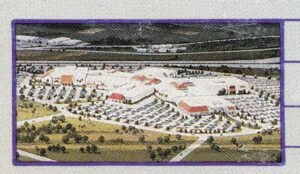
The PE article takes a look at a local “land battle” that began in the early- to mid-1980s between the city of Riverside and the then newly incorporated (1984) city of Moreno Valley. The initial battle involved a large chunk of land alongside Interstate 215 just east of the Riverside city limits. The owner had proposed a large regional mall (Canyon Springs Fashion Mall) and had wanted a Riverside address. But, there was a problem.
The then-forming city of Moreno Valley also had its eyes on the same chunk of land and it too wanted a piece of the proposed mall’s potential sales tax revenue. After much wrangling, the land was eventually allowed to annex to Riverside, but not before creating a few initial wounds as well as setting the tone for a cross-street battle that continues somewhat to this day:

Day Street marks the dividing line between Moreno Valley and Riverside and the flash point for a renewed economic rivalry as each city fights for shoppers’ dollars.
Riverside Press-Enterprise – December 1, 2003
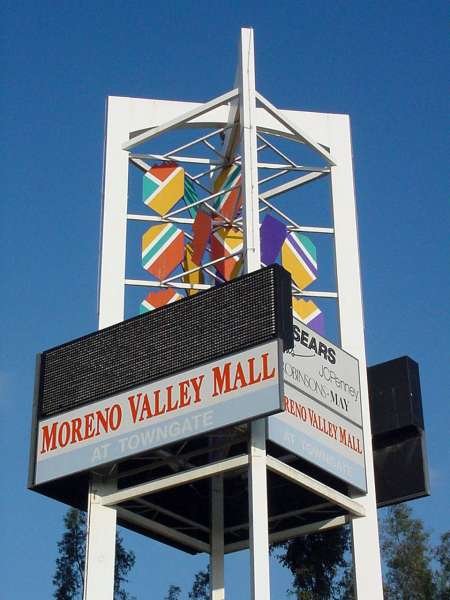
For those wondering, the proposed Canyon Springs Mall (Riverside) eventually fell through only to be supplanted by the Moreno Valley Mall at Towngate (1992), which lies across Day Street on the former Riverside International Raceway property. (The raceway property was annexed into Moreno Valley in 1987 — three years after incorporation was approved by voters in November 1984.)

Both sides of the street more-or-less languished in the doldrums for a number of years until a recent retail boom brought the immediate area out of hibernation. Of course, Moreno Valley got the mall and immediate success, but it has been the Canyon Springs side in Riverside in which most of the boom of late has taken shape, mostly in the form of a rising retail power center with Best Buy, Target, Pier 1, Wal-Mart, PetsMart, and Michaels among others.
In fact, it was the recent move by Target in closing its Moreno Valley location for the new Canyon Springs store that resurrected some of the old animosities between the two cities over the whole Canyon Springs annexation from 20 years earlier.
Fortunately, Riverside and Moreno Valley have agreed to a truce so as to reduce the chance of continuing the “sales tax wars” in perpetuity. And that can be nothing but good news for all.
Related
- Riverside Press-Enterprise – Cities fight over retail dollars (Dec. 1) | Riverside fired first shot in ‘mall wars’ (Dec. 1) | Cities agree to end competition (Nov. 13)
- RaincrossSquare.com – Riverside International Raceway (Dec. 2003)
Correction: Clarified the annexation date (1987) for the raceway property into the City of Moreno Valley.
Sources: Riverside Press-Enterprise (PE-20031201, PE-20031113); NOTE: Published dates for some online versions of newspaper articles cited may not match their archival source date.
2024 PAGE UPDATE: Added newspaper citation/insert; removed outdated links to newspaper articles.

One Comment