
Time to grow up
If population projections released this past week come to fruition, Riverside County will be the second most-populous county in California by 2050, ranking behind only behemoth Los Angeles County.

The report, issued by the California Department of Finance — the folks responsible for statewide fiscal planning and demographics — says Riverside County can expect to house 4.7 million residents in about 40 years. This would move the county from its current spot as the fourth most-populous to the No. 2 spot, with only Los Angeles County’s projected 13.1 million being larger (indeed, much larger). San Bernardino County is projected to remain the fifth most-populous with 3.7 million.
If recent history is a guide, however, one thing is certain — we cannot simply ignore the potential numbers. Although there’s no guarantee that all 2.5-plus million residents will actually arrive as projected, there’s no doubt Riverside County will still absorb a large amount of future growth (as we’ve learned over the past 40 years). So too will San Bernardino County. Thus, ignoring the growth is not the answer — but aggressively planning for it is.

Therefore, the question is, will local officials and residents alike simply allow development to continue sprawling outward? Or, will we begin to realize — and accept — the time has come to begin growing upward?
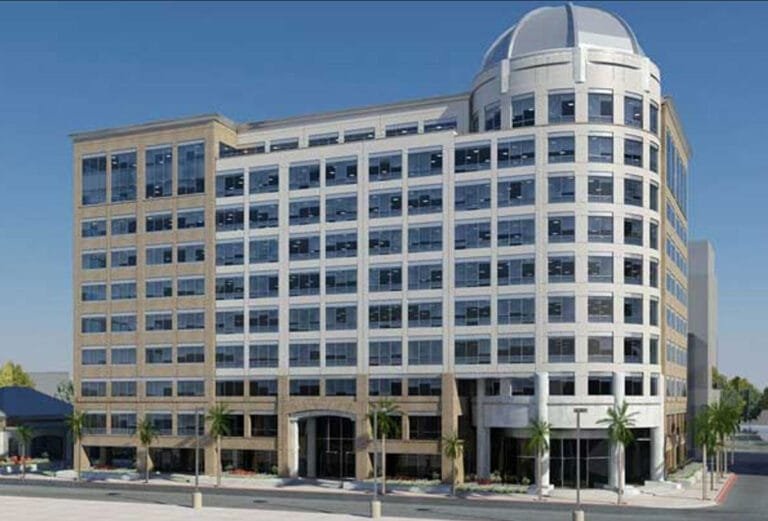
In our opinion, we do not see any other option but upward. We’re not talking a forest of 50-story towers. Instead, we’re envisioning pockets of mixed-use, higher density developments consisting of modest 15-, 20- and 30-story buildings, mostly in the existing downtowns of Riverside and San Bernardino and possibly even Ontario. Likewise, we hope to see smaller clusters consisting of 5-, 10- and 15-story buildings in some portions of Corona, Rancho Cucamonga, Fontana, Moreno Valley, Temecula, Murrieta and even Redlands. Such would greatly increase future options in living, working, transportation and cultural amenities while still maintaining the viability of existing lifestyles. In essence, simply adding balance to the current landscape.
Census: 2050
California’s 10 most-populous counties
(w/ 2000 ranking)
- 1. Los Angeles – 13.06m (1)
- 2. Riverside – 4.73m (6)
- 3. San Diego – 4.50m (3)
- 4. Orange – 3.98m (2)
- 5. San Bernardino – 3.66m (4)
- 6. Santa Clara (San Jose) – 2.62m (5)
- 7. Sacramento – 2.17m (8)
- 8. Kern – 2.10m (14)
- 9. Alameda (Oakland) – 2.04m (7)
- 10. Fresno – 1.92m (10)
Indeed, Inland Southern California cannot continue spreading outward, if only for two major reasons — lack of efficient, multi-modal transportation and the need for stronger, more diversified employment centers. It’s becoming more evident that continuing current development patterns is simply too expensive — everything from environmental concerns and infrastructure constraints (think: freeway gridlock) to overall quality of life.
Quite frankly, do we really want our children and their children to spend countless hours commuting to LA, Orange and San Diego counties as many of us and our parents before have done? Whether it be for employment or even entertainment purposes, we think the smart answer is an emphatic “No.”
Thus, it’s now time to grow up.
Related
- Riverside Press-Enterprise – Riverside County population forecast to double by 2050, ranking it No. 2 in state
- Ontario Daily Bulletin – Population to double by 2050
- Los Angeles Times – 60 million Californians by mid-century
- California – Department of Finance
Previous
- RaincrossSquare.com – Mixed-use projects picking up steam in Riverside (July 2007) | Census: Riverside County third in total residents added since 2000 (March 2007) | 4 million and counting (Dec. 2006) | Inland growth driving SoCal region (Dec. 2006) | ‘A Sleeping Giant’ – part deux (Feb. 2006)
I agree on the building up. It is feasable and smart. The idea of what The washington, D.C. area is, around transportation hubs (main subway/train/bus stations), they build up with 10, 15, 20 story buildings, mainly office and apartments. it’s right there on the foot steps of commuter lines, and in these developments there are also live/work units. at the base (1st floor) of the high rises are shops, dining, bars and specialty shops. Riverside planners should take a trip there and have a look…it works. everything in one condensed area (high density). It needs to be done. the land needs to be preserved with open spaces for people to go and relax or what have you. it’s time to build and build upwards smartly. lets not sprawl over thousands of miles like LA and compound the commuting and traffic problems.
Yes, the idea of being able to build efficient and effective “transportation hubs” is one of the key aspects of adding limited density as opposed to sprawl. And, as you too mentioned, decreasing sprawl will help preserve open space.
Again, our position is not about replacing large swaths of existing single-family homes (nor keep then from being built), but it’s about adding both “balance” to the current landscape and “choices” to the current marketplace (as well as increasing potential transportation options).
Thanks for posting.