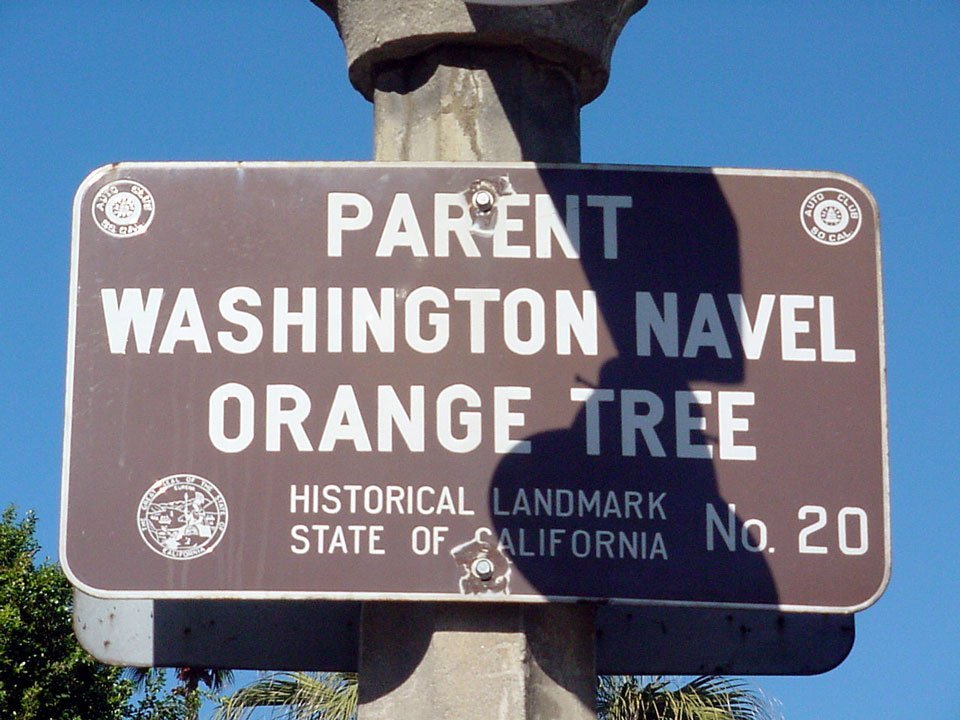
2000- California Historical Landmark No. 20 located in Riverside (RXSQ)

Riverside’s navel orange
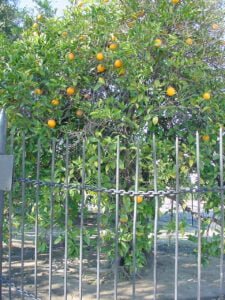
From a recent edition of the Los Angeles Times:

The bronze plaque tells the tale: “The most valuable fruit introduction yet made by the United States Department of Agriculture.”

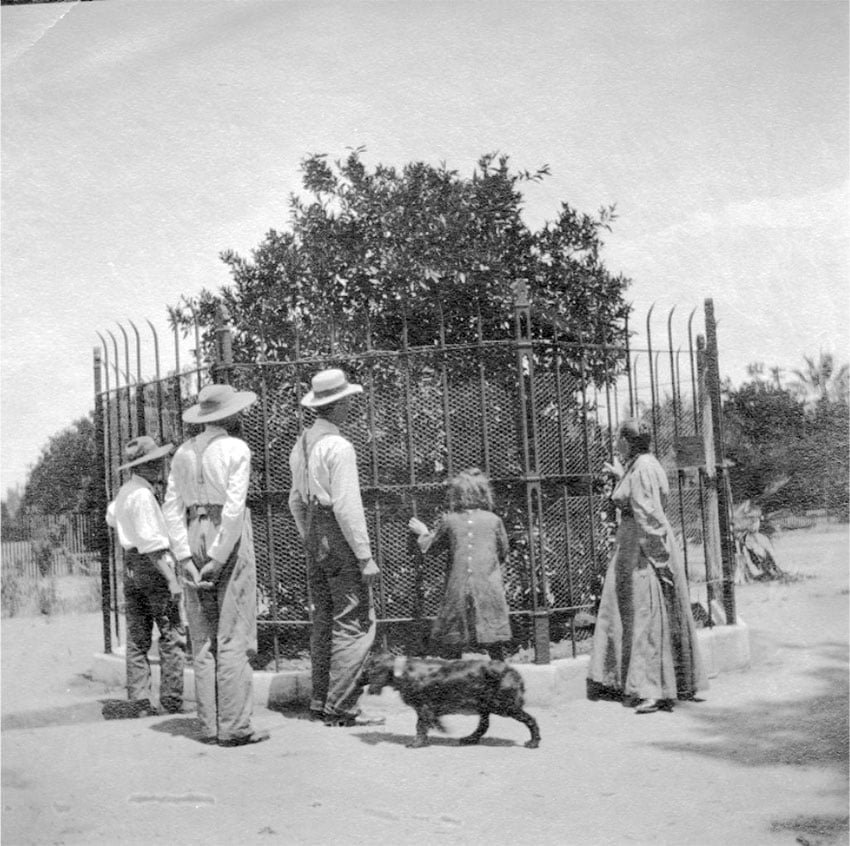
And there, at Magnolia and Arlington avenues in Riverside, stands the last of California’s original Washington navel orange trees, enclosed by an iron fence, looming over the plaque in the summer sun.

It is the tree that launched the storied citrus industry in the Riverside area, an industry that helped shape the world’s view of Southern California as a tropical paradise in the early 20th century.

Los Angeles Times – August 5, 2004
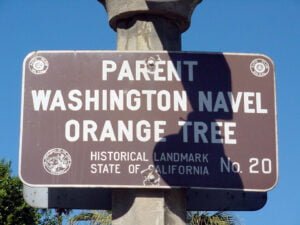
For those who don’t know, from this very navel orange tree (and a second sibling tree that died long ago) descended every Washington Navel orange tree in California, spawning California’s highly-successful — and very lucrative — navel orange industry. Some historians have referred to it as the second “gold rush” for California.

Related


02d-pc-riv-1950s-navel-001ac-A-800.jpg
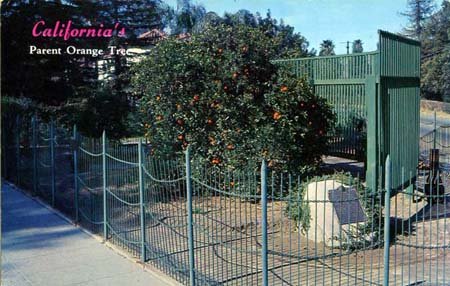
Image 5 of 60

Throughout the years, Riverside's parent Washington Navel orange tree has been featured on numerous postcards, this one from the 1950s. "Riverside, California - This historic orange tree is one of the two original trees from which all of California's Washington Navel orange trees have descended from and from which has evolved a multi-million dollar industry. The original stock was imported from Bahia, Brazil in 1870."
Sources: Los Angeles Times (LAT-20040805), California Citrus State Historic Park; NOTE: Published dates for some online versions of newspaper articles cited may not match their archival source date.

2024 PAGE UPDATE: Added additional info/context; added link to June 2019 news article; removed outdated link to photo gallery and added 2011 photo slideshow.

Similar Posts

  • Inside the long-shuttered doors of 3750 Main Street

    What does one find upon entering a building that’s been out of public use for much of the past 40 years? A few weeks back, we were lucky enough to find out as we ventured along with fellow Old Riverside Foundation members into the long-shuttered Franzen’s/Westbrook’s/Imperial hardware building located on the pedestrian mall at 3750…

  • Julius Shulman

    Probably no other photographer had as much an impact on presenting — even selling — Mid-Century Modern architecture than did Julius Shulman, who died Wednesday in Los Angeles. He was 98. Among the many photographs taken by Shulman were projects by the likes of Richard Neutra, Rudolf M. Schindler, Charles Eames, Albert Frey, Pierre Koenig,…

  • Riverside Roundup – 09/13/2008

    Neighborhood community center opens 2008Orange Terrace Community Center Riverside unveiled the latest project from the city’s “Riverside Renaissance” initiative as the Orange Terrace Community Center opened to the public early Saturday. Located on the grounds of the Orange Terrace Community Park, the $11 million facility includes a gymnasium, banquet hall and multipurpose room. Also included…

  • AllianceCalifornia

    After nearly a decade in the doldrums, the former Norton Air Force Base in San Bernardino is experiencing a rebirth. The airfield — since renamed San Bernardino International Airport — has struggled in its attempts to land passenger and cargo service. But a major Texas development company has recently brought in three high-profile tenants to…

  • Bookshelf: Riverside’s Invisible Past

    The latest book documenting Riverside’s history has just hit the bookshelves. Written by fourth-generation resident of Riverside Joan H. Hall, “Riverside’s Invisible Past” is the latest in several local history books by Joan, many of which are must-haves. The 192-page book is chock full of interesting and informative histories surrounding 52 structures and sites from…

  • | |

    Gallery: Riverside — Main Street Pedestrian Mall

    Following the 1956-57 opening of the Riverside Plaza mall, downtown shopping began a slow but steady decline. In response, city leaders quickly began working at remaking the city’s civic center. Discussions took place regarding additional parking, modernized storefronts, and streetscape improvements. In June 1958, Los Angeles architectural firm Welton Beckett & Associates presented a downtown…

Leave a Reply

Your email address will not be published. Required fields are marked *

This site uses Akismet to reduce spam. Learn how your comment data is processed.